Let me introduce my AIM Framework (Autonomy Impact Matrix). Before building an AI agent, I ask one question:
Does this problem actually need autonomy?
Over the past few months, I've been building production-grade agentic AI systems. One lesson keeps repeating itself: the hardest part isn't building the agent. It's deciding whether an agent should exist in the first place.
Too many products are becoming "agentic" simply because the technology is available. Unfortunately, autonomy also introduces more complexity, cost, governance, and failure modes.
That's why I started using a simple decision model before writing a single PRD.
The five dimensions
The AIM Framework evaluates five dimensions:
- Problem Complexity — Does the task require planning and multi-step reasoning?
- Actionability — Should the AI actually execute work instead of just making recommendations?
- Human Bottleneck — Is manual effort slowing the business down?
- ROI vs Risk — Will autonomy generate more value than the operational and governance cost?
- Environment Stability — Are APIs, business rules, and workflows predictable enough for reliable execution?
Scoring
I score each area from 1–5:
| Score | Verdict |
|---|---|
| 21–25 | Build a fully autonomous agent |
| 16–20 | Keep humans in the loop with approvals |
| 10–15 | An AI copilot or workflow automation is probably enough |
| Below 10 | Traditional software is likely the better product |
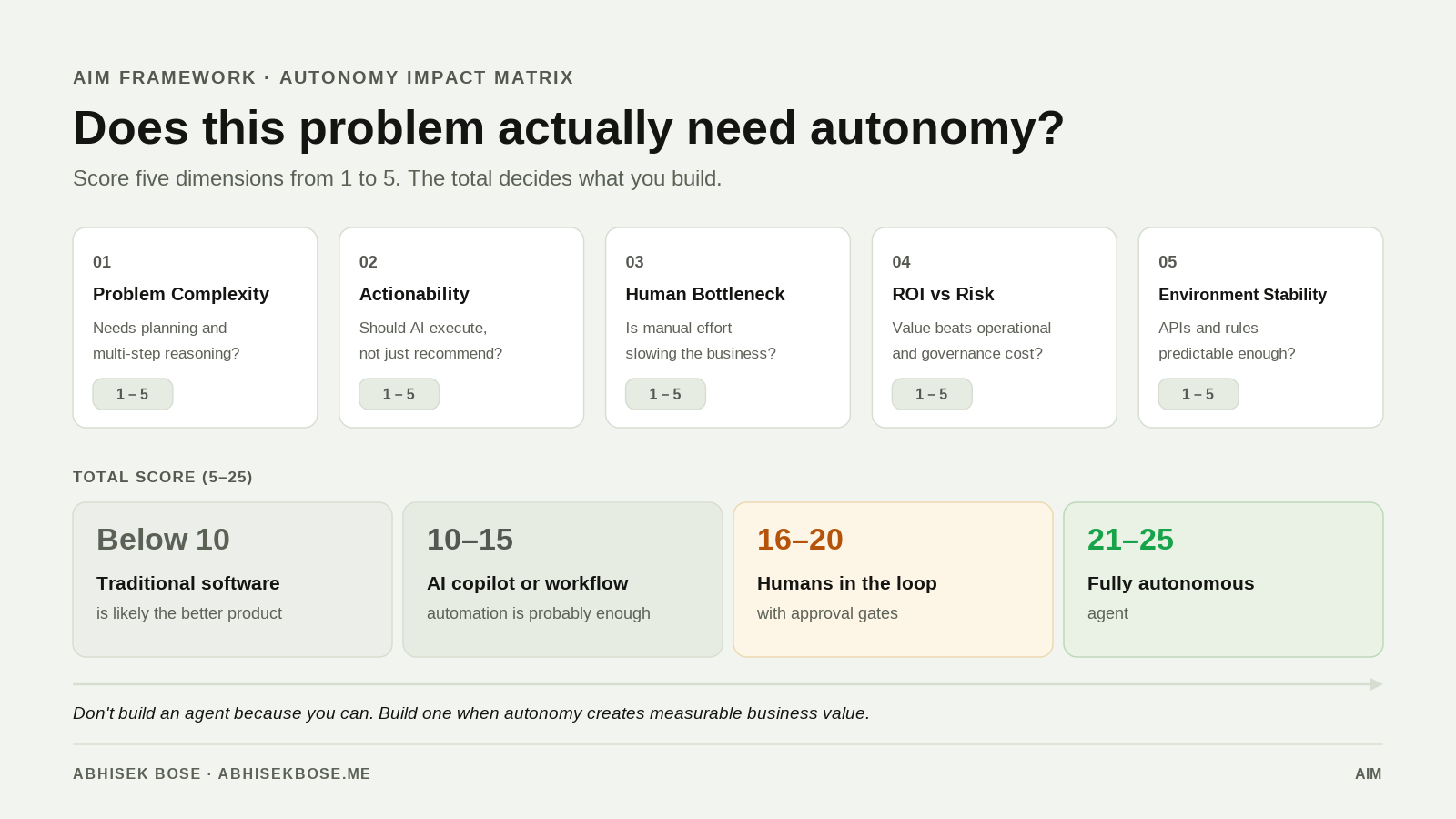
One principle has changed how I think about AI products: don't build an agent because you can. Build one only when autonomy creates measurable business value.
That's the purpose of the AIM Framework. Simple enough to use during product discovery. Practical enough to prevent building the wrong product.
Originally published on LinkedIn. This framework decided the shape of DeepAgent for funnels.