The next shift in AI may not be bigger models. It may be a different architecture.
We've been putting one LLM in the middle of everything:
Input → LLM → Text → Parser → Application
But software rarely needs "text." It needs decisions.
- Should this transaction be approved?
- Which workflow should run?
- Which tool should an agent use?
- Should this ticket go to Billing or Engineering?
- Does this need human review?
Decision models
That's where Jev AI, from TypeSafe, gets interesting. Instead of asking an LLM to generate an answer and then parsing it, Jev is designed to return structured decisions from application state.
Application → Jev → Decision → Workflow
What could this enable?
- Customer support routing
- Fraud & risk scoring
- AI agent tool selection
- Content moderation
- Document approval
- AI quality evaluation
- Human-in-the-loop workflows
Bigger than any one tool
The architectural idea is bigger than Jev itself. We may start seeing AI systems where:
- Large models reason.
- Generative models communicate.
- Decision models classify.
- Traditional code executes.
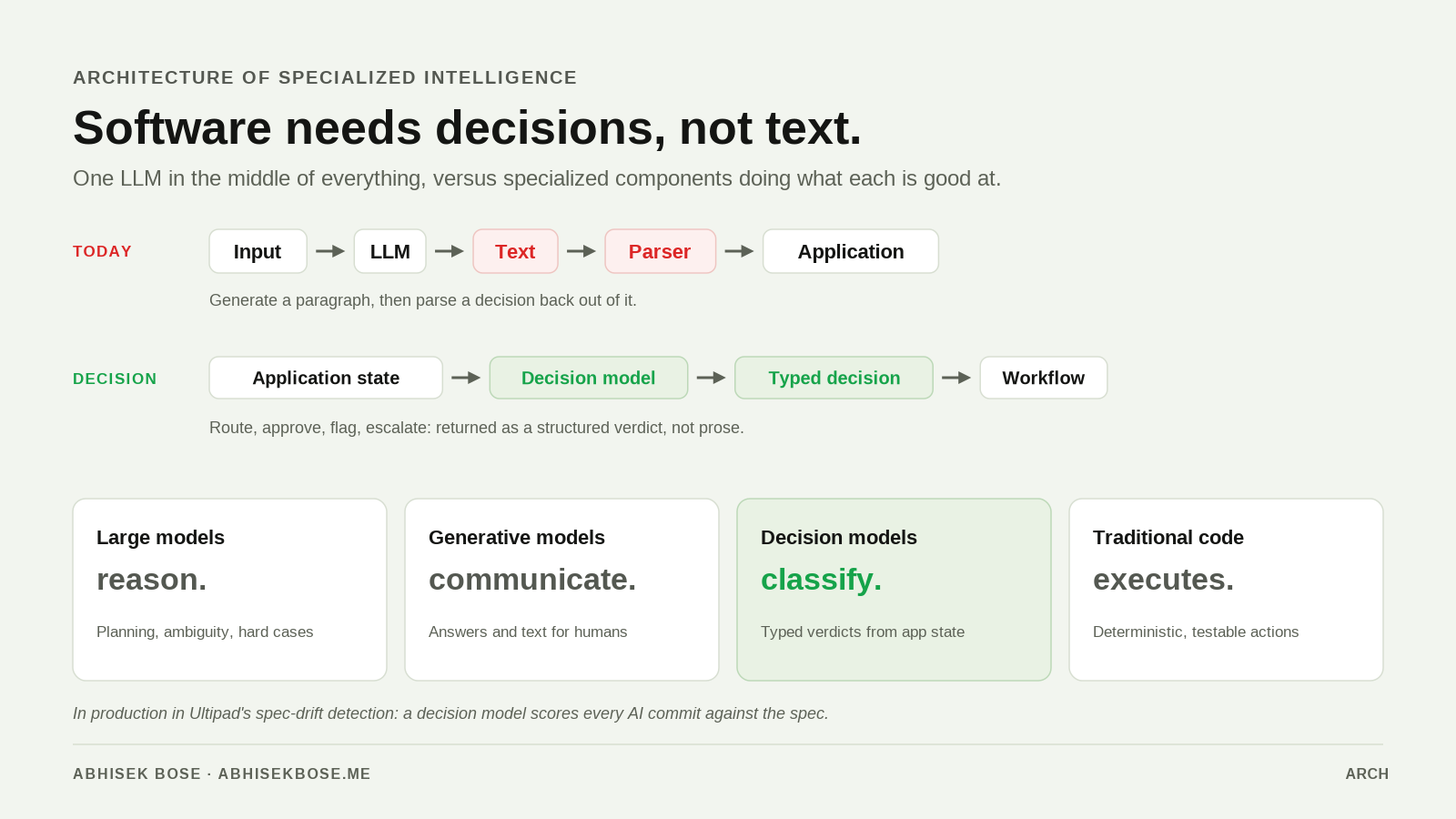
Not one model doing everything. A system of specialized AI components doing what each is actually good at.
Jev is still early, and its published benchmarks are primarily TypeSafe's own evaluations. But the direction is worth watching.
The future of AI software may not be one giant model. It may be an architecture of specialized intelligence.
Originally published on LinkedIn. This architecture runs in production in Ultipad's spec-drift detection.