Shipped: an AI docs assistant that a client's dev teams use in production daily.
Over the last few months, I built an AI documentation assistant that a client's developer teams now use in production every day. I was the product manager. I was also the entire engineering team.
The problem
40+ pages of platform docs, and integration developers blocked on the same questions every week. Every question became a support ticket. 15 to 30 minutes of an engineer's time, hours of waiting for the developer. And when developers guessed instead of asking, they shipped code against field names a generic chatbot invented.
What I built
A self-hosted RAG pipeline over the official docs. Hybrid retrieval (semantic + keyword + HyDE), cross-encoder reranking, intent-based model routing, prompt caching, UI screenshots embedded inline, and a live hallucination tripwire that warns on any identifier the docs can't verify.
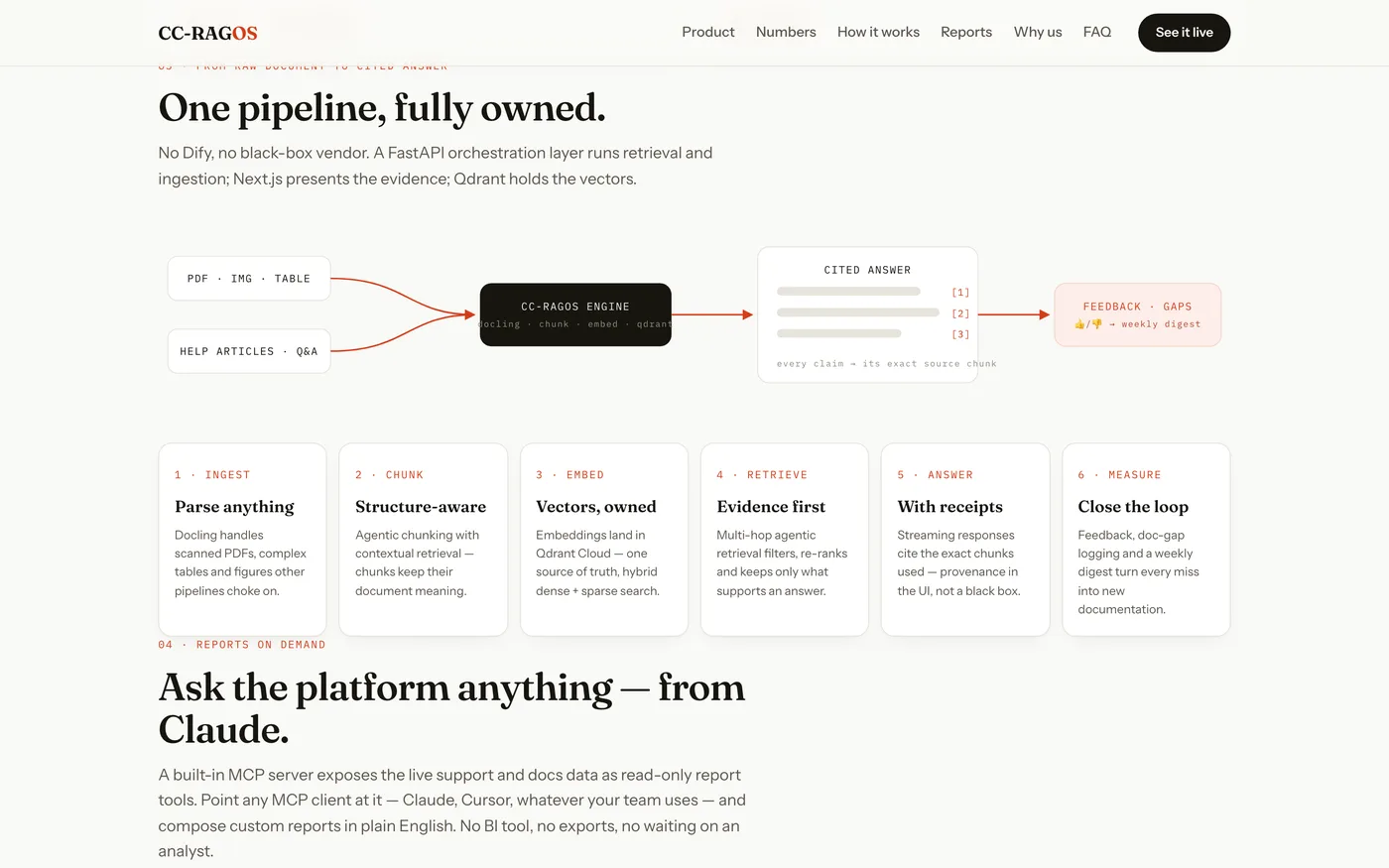
The pipeline as it runs today in RAGOS: ingest → chunk → embed (hybrid dense + sparse) → retrieve and rerank → answer with citations → measure, with doc gaps fed back into the documentation.
The part I'm proudest of: no release ships on vibes. Every deploy runs a golden-set eval gate scored by an LLM judge, with half the test questions harvested from real user feedback. Fail the gate and the deploy rolls back automatically. It has already blocked bad releases, and caught a provider outage before I did.
The numbers — from the eval pipeline, not my imagination
- 94 to 100% of answers judge-verified as grounded in the docs they cite
- Right documents retrieved: 0.69 to 0.92 in three weeks of iteration
- Median answer time: ~10s down to ~5s
- Truncated answers: 5.2% down to 0% (a real user complaint found it)
- Cost: ~$0.001 per answered question
- ~100 developer questions a week that no longer become tickets. At ~15 minutes each, that's an estimated 20+ hours of support capacity returned to the team every week.