Scenario: Tear down Ultipad — my own ADLC platform — with the same rigor I apply to Copilot and Devin. I built this. Here is where my own framework says it's weak.
01 · The thesis
Ultipad's bet: agents shouldn't build without approved intent. A human-approved spec gate before the agent writes a line, spec-drift detection scoring every commit after. That's the product.
The honest problem: the gate is the product AND the adoption tax. The ceremony that protects a team is friction that a solo user skips. Every hour of evidence entry, decision logging, and spec approval is an hour the user could have spent prompting Cursor directly — and they know it.
My thesis: the loop must earn its ceremony. Start advisory, prove value per artifact, let trust escalate. A gate nobody walks through protects nothing.
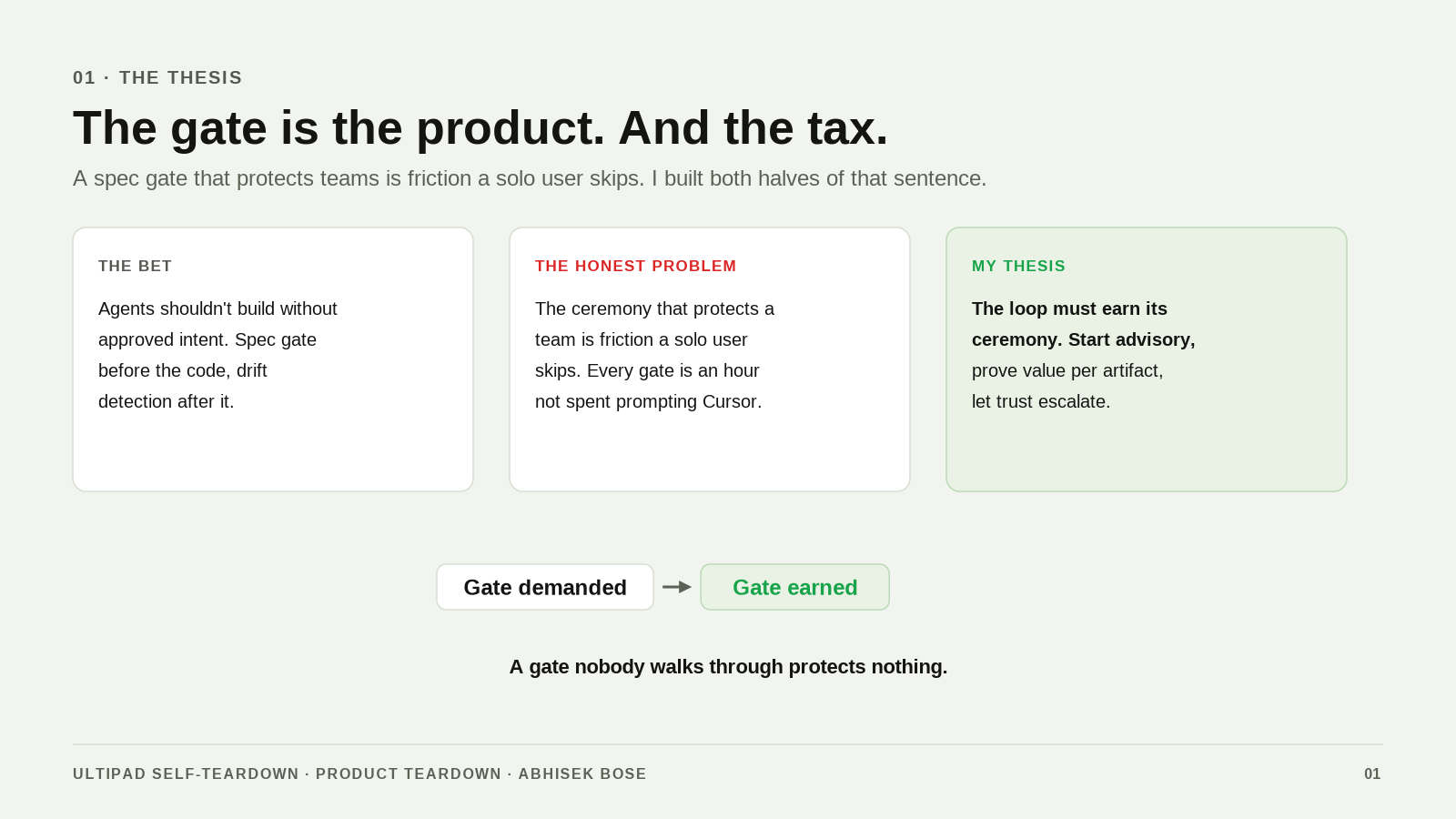
The bet, the tax, and the fix — on one screen, from the person who built it.
02 · Product evolution
Ultipad grew the way conviction products grow: each layer made the loop more complete and asked the user for more work before the payoff. Trace the eras honestly and the adoption tax compounds in plain sight:
| Era | User does | System guarantees | Adoption tax |
|---|---|---|---|
| Evidence capture | Enters customer signals | A traceable "why" per idea | Manual entry, no agent value yet |
| Decisions | Logs and scores decisions | One place intent lives | More writing, still no agent value |
| Agent Specs | Drafts + approves the spec | Agents can't build unapproved intent | The approval gate itself |
| MCP context serving | Configures the 35-tool server | Agents read the product graph | Install + auth, dev-side |
| Drift detection | Nothing — it's automatic | Every commit scored against spec | Zero — the first free layer |
| Cost attribution | Nothing — it's automatic | AI spend attributed per idea | Zero |
The pattern is backwards. The zero-tax layers — the ones that deliver value without asking for labor — sit at the end of the funnel, behind three layers of manual ceremony. The user pays first and gets paid last.
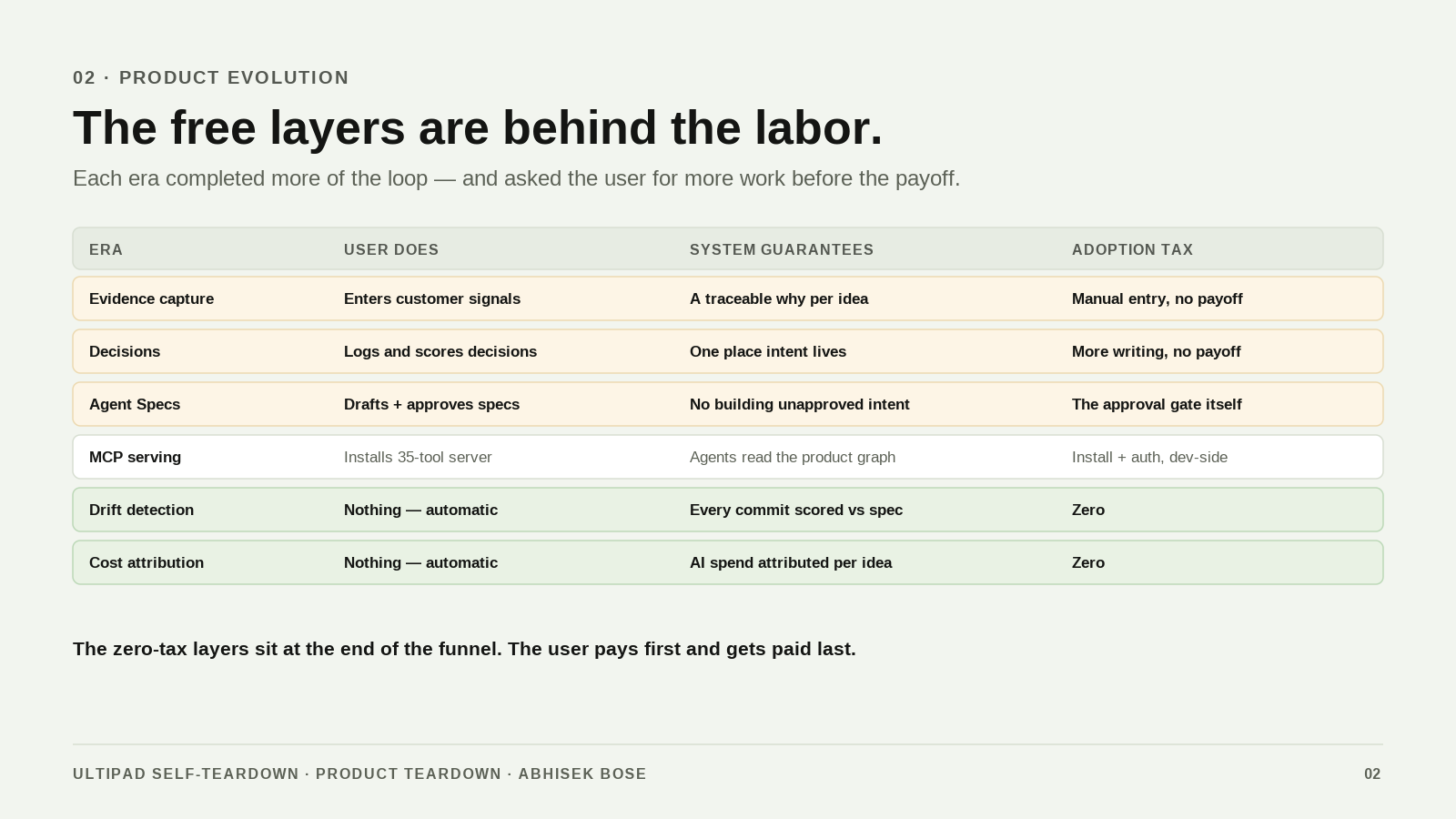
The free layers are at the end of the funnel. The labor is at the front. That's inverted.
03 · Who actually has this problem
Three personas, and the honest axis isn't trust threshold — it's ceremony tolerance:
- Solo builder with agents — job: ship faster with Claude Code or Cursor. Wants speed, skips ceremony, will not write evidence entries for an audience of one. Ceremony tolerance: near zero. Churn risk, not a customer.
- PM at an AI-first startup — job: own the roadmap while agents do 40–70% of the implementation. Owns the roadmap, doesn't own the agents — and answers for the gap between them. Ceremony tolerance: high, because the ceremony is her job description. This is the true ICP.
- Eng + PM pair at a mid-market company — job: govern agent output without slowing the team. The buyer/user split: the PM buys Ultipad, but the devs must install the MCP server and route their agent sessions through it. Ceremony tolerance: split down the middle. Distribution risk lives here — the buyer's enthusiasm doesn't install anything.
The uncomfortable read: the persona most likely to discover Ultipad organically (the solo builder) is the one the ceremony punishes hardest, and the persona the product serves best (the PM) can't complete adoption alone.
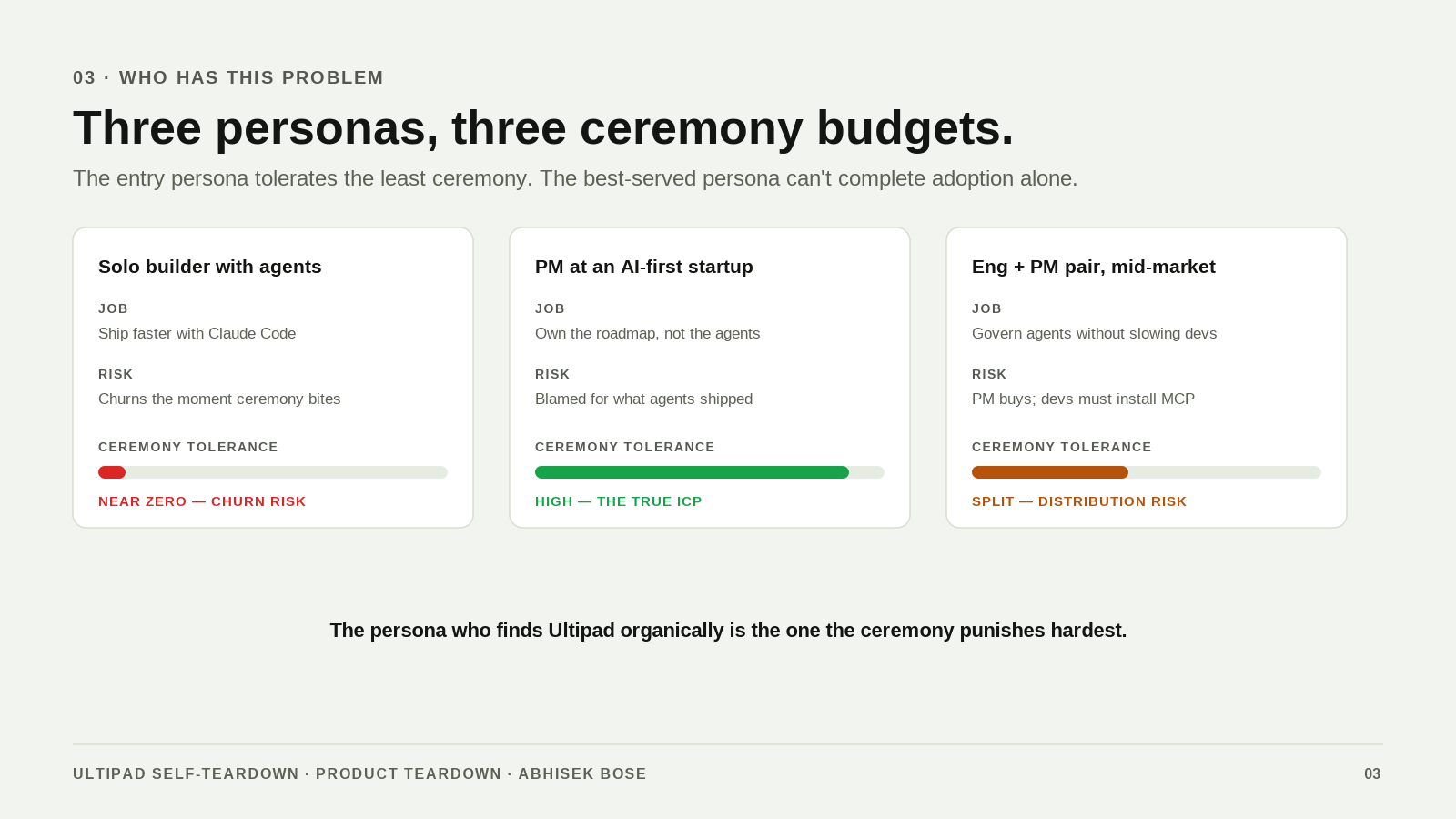
Ceremony tolerance is the real segmentation axis — and the entry persona has the least of it.
04 · Jobs to be done
Functional JTBD: I want agents that know what to build — better output from the same prompt, now.
Emotional JTBD: I want to stop being the person blamed for what shipped.
Trust JTBD: I need to prove that every commit traces to an approved intent.
Honest note: the trust job is Ultipad's whole thesis. But the functional job — better agent output now — is what users actually show up for. Leading with ceremony serves the trust job at the functional job's expense. The Copilot teardown I wrote says the trust boundary should move to intent approval; this teardown has to admit that a user who hasn't felt the functional payoff yet has no reason to pay the intent tax.
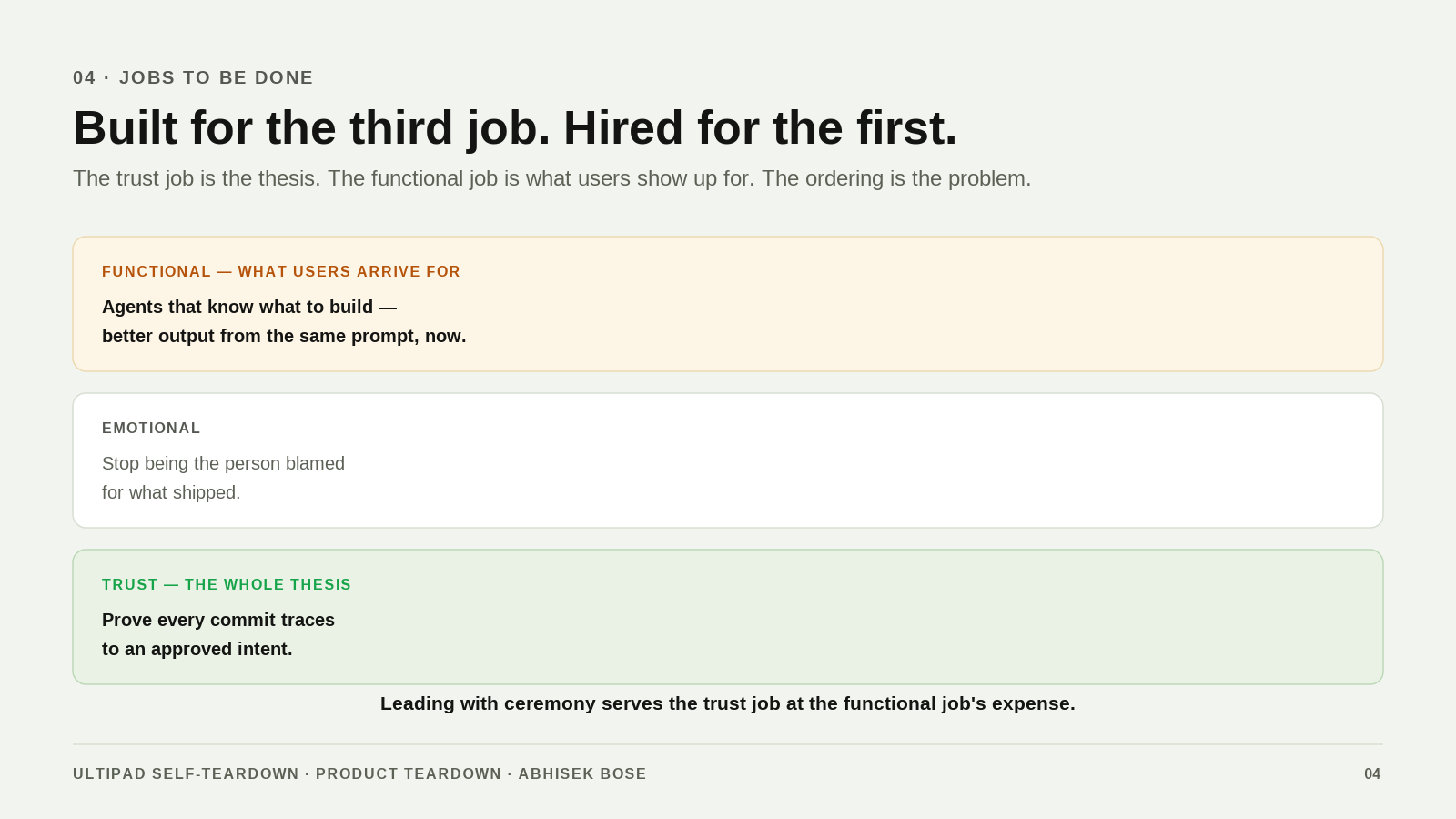
The product is built for the third job. Users arrive for the first one. That ordering is the whole problem.
05 · How the product actually works
The loop is real and it's shipped. Eight stages: customer evidence → product decision → specification → agent context → coding agent → code/PR → shipped outcome → measurement. The 35-tool MCP server serves approved specs to Claude Code, Cursor, or Codex; the agent writes back commits, progress, and completed stories; drift scoring runs on every commit against the approved spec. Live, in beta, and dogfooded — most of Ultipad was built through Ultipad's own loop.
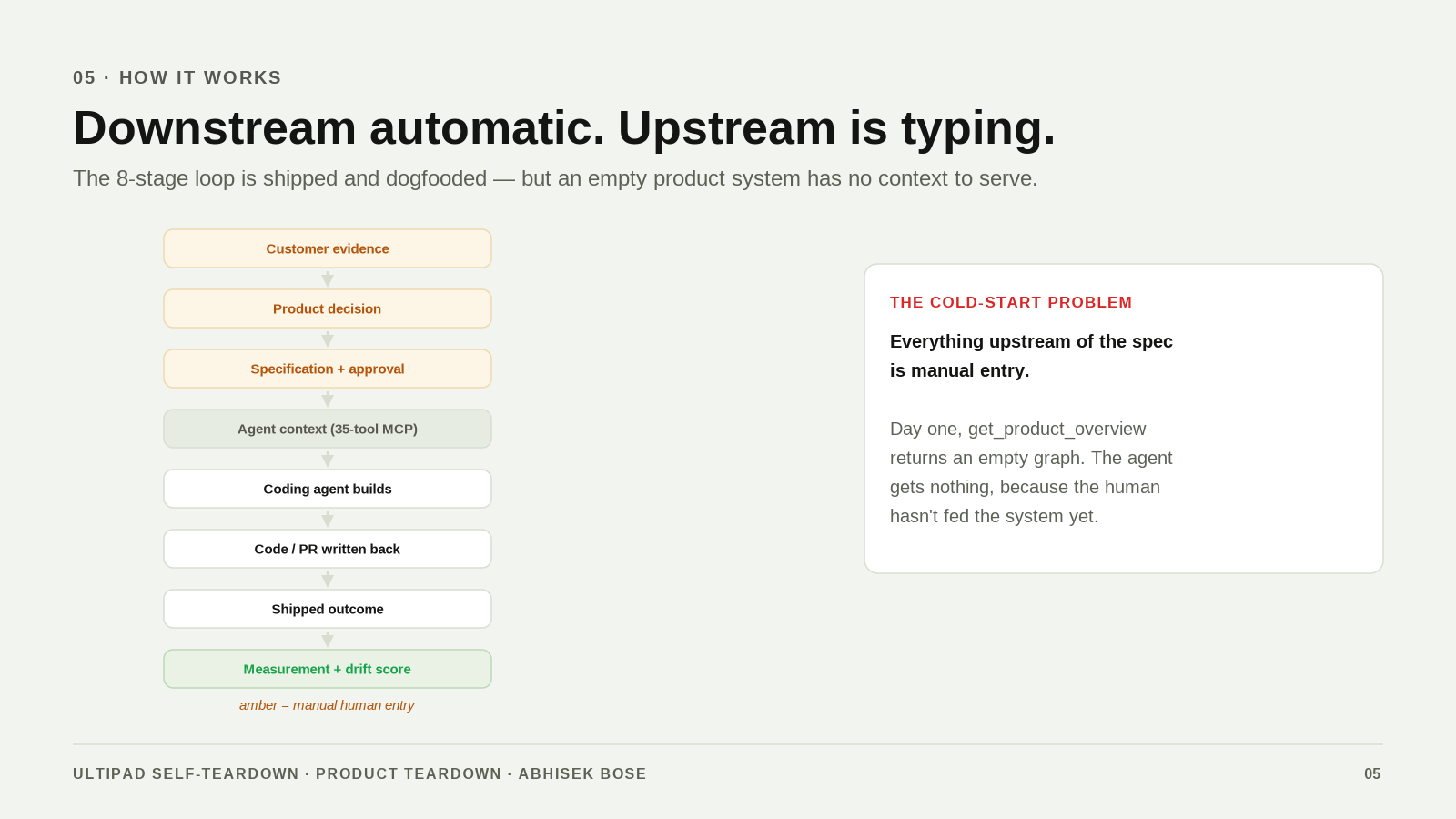
The downstream half is automatic. The upstream half is typing.
Now the part the case study doesn't dwell on: evidence intake has pipes (portals, REST, Slack, Zapier, CSV), but decisions and spec drafts are still human labor, and the pipes only help once someone wires them. That's the cold-start problem, and it's structural: an empty product system has no context to serve. Day one, the MCP server answers get_product_overview with an empty graph. The agent gets nothing, because the human hasn't fed it yet. The product's value is gated on labor the product hasn't earned.
06 · Where the loop breaks
Map the loop end to end and two break points appear — neither of them is a bug:
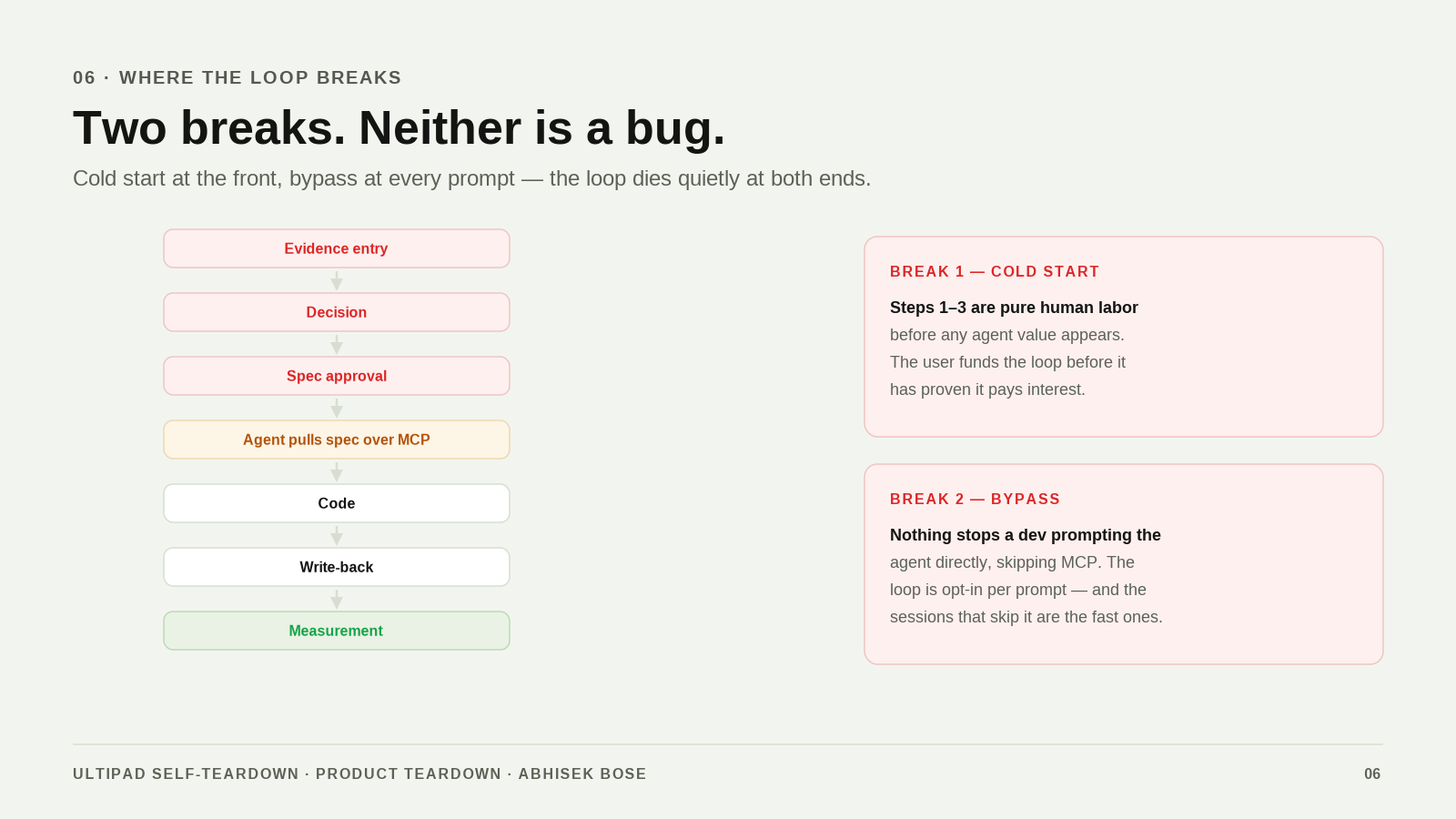
Seven steps. Two places the loop dies quietly — at the start, and at any prompt.
Break 1 — cold start. Steps one through three are pure human labor before any agent value appears. The user is asked to fund the loop before the loop has proven it pays interest.
Break 2 — bypass. Nothing stops a developer from prompting the agent directly and skipping the MCP pull entirely. The loop is opt-in per prompt. Ultipad governs the sessions that route through it and is blind to the ones that don't — and the ones that don't are the fast ones.
07 · The real product gap — a concrete scenario
A two-person startup adopts Ultipad. Week one is the demo working as designed: the PM writes evidence, drafts and approves a spec, the agent pulls it over MCP, builds on-spec, writes the commit back. Drift score comes in aligned. Magic. This is the loop the case study shows, and it's real.
Week three, deadline pressure. The dev prompts Cursor directly — no spec pull, no MCP session, just a prompt and a deadline. The feature ships untraced. And here's the part that keeps me honest: the drift dashboard shows nothing. Not a flag, not a warning — nothing, because the loop never started. Drift detection scores commits that enter the loop; it cannot see commits that never did.
The system's value degrades silently with each bypass. Adoption failure looks exactly like success: a clean dashboard, no flags, everything green. The most dangerous state of my own product is the one that looks healthiest.
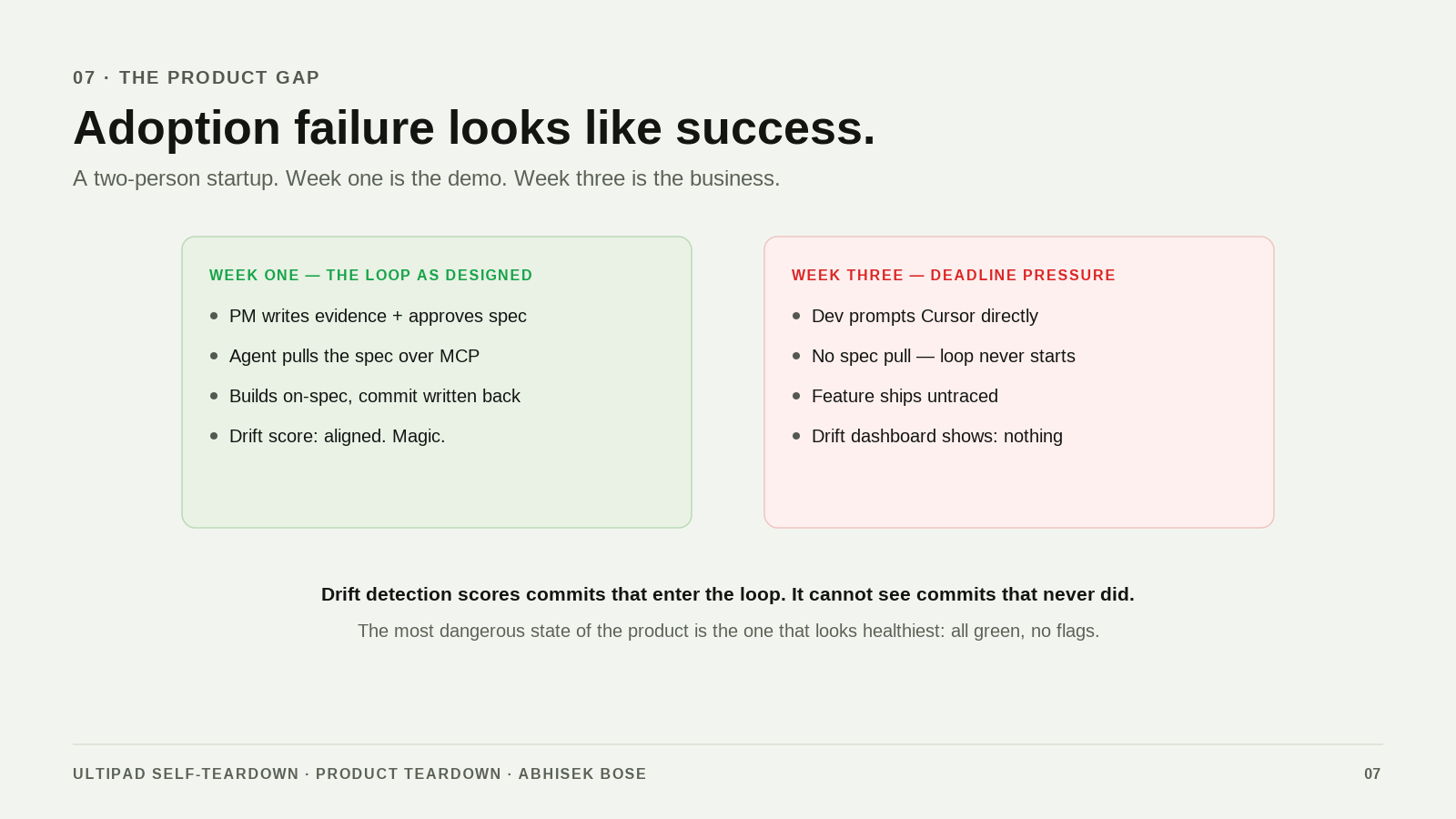
Week one is the demo. Week three is the business. The dashboard can't tell them apart.
08 · Current vs proposed
Current — ceremony-first: write evidence → log the decision → draft the spec → approve it → then agents benefit. Four human steps before the first unit of agent value.
Proposed — value-first inversion: the agent starts from a bare prompt, exactly the way developers already work. Ultipad auto-drafts the spec from the prompt plus code context. The human approves retroactively — cheap, one glance, because the spec was written for them. Evidence links attach later, as the graph fills in. The loop assembles itself behind the user instead of demanding assembly up front.
The gate earned nothing if nobody walks through it. Meet the user at the prompt, then earn the loop.
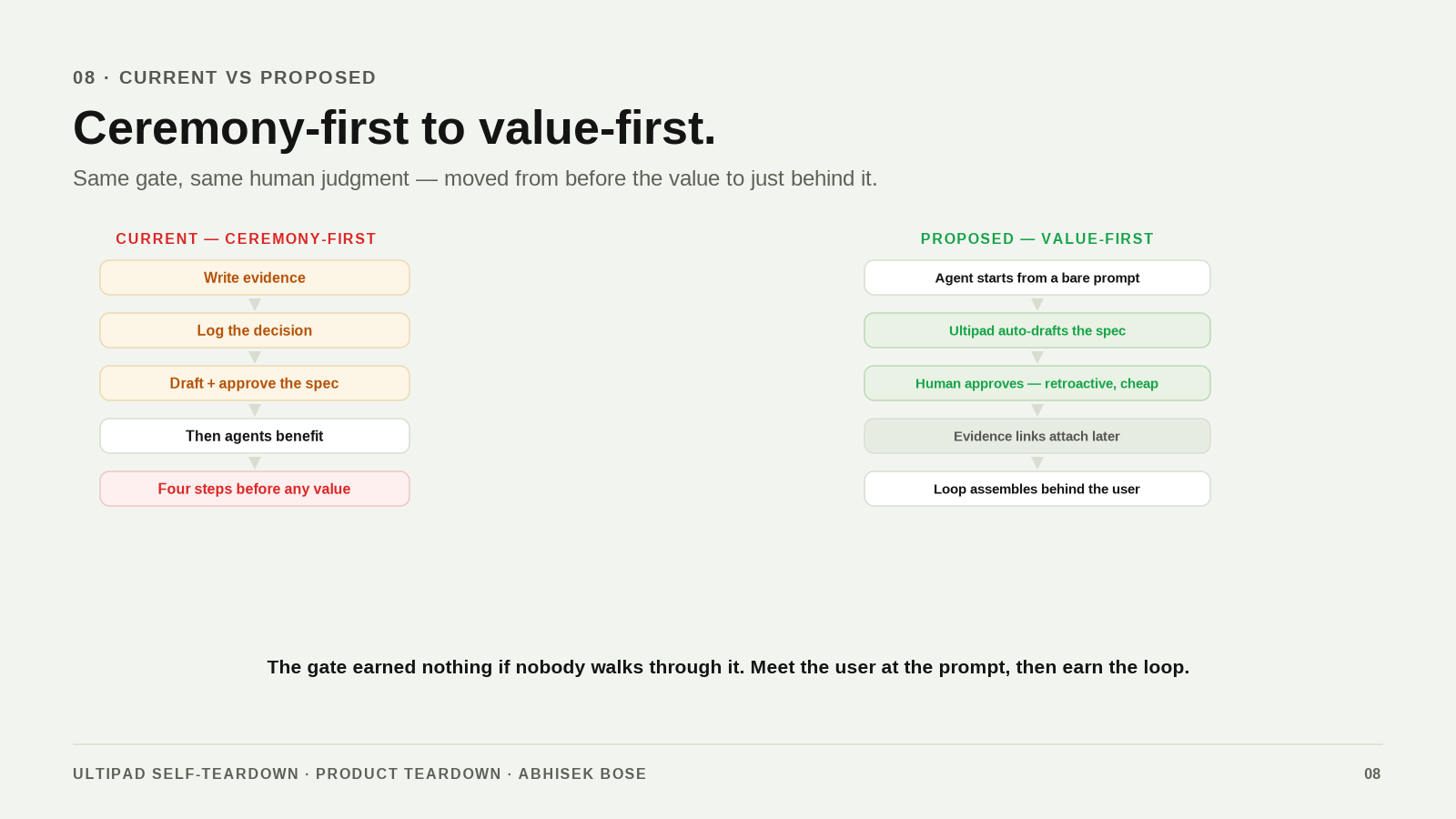
Same gate, same human judgment — moved from before the value to just behind it.
09 · The artifact: the spec-drift report
Drift detection is Ultipad's best shipped idea — every AI commit scored in real time against the approved spec, on-spec around 89% aligned passes, an unrelated commit around 25% flags to the owner, advisory and never blocking. This is its ideal form as a product surface:
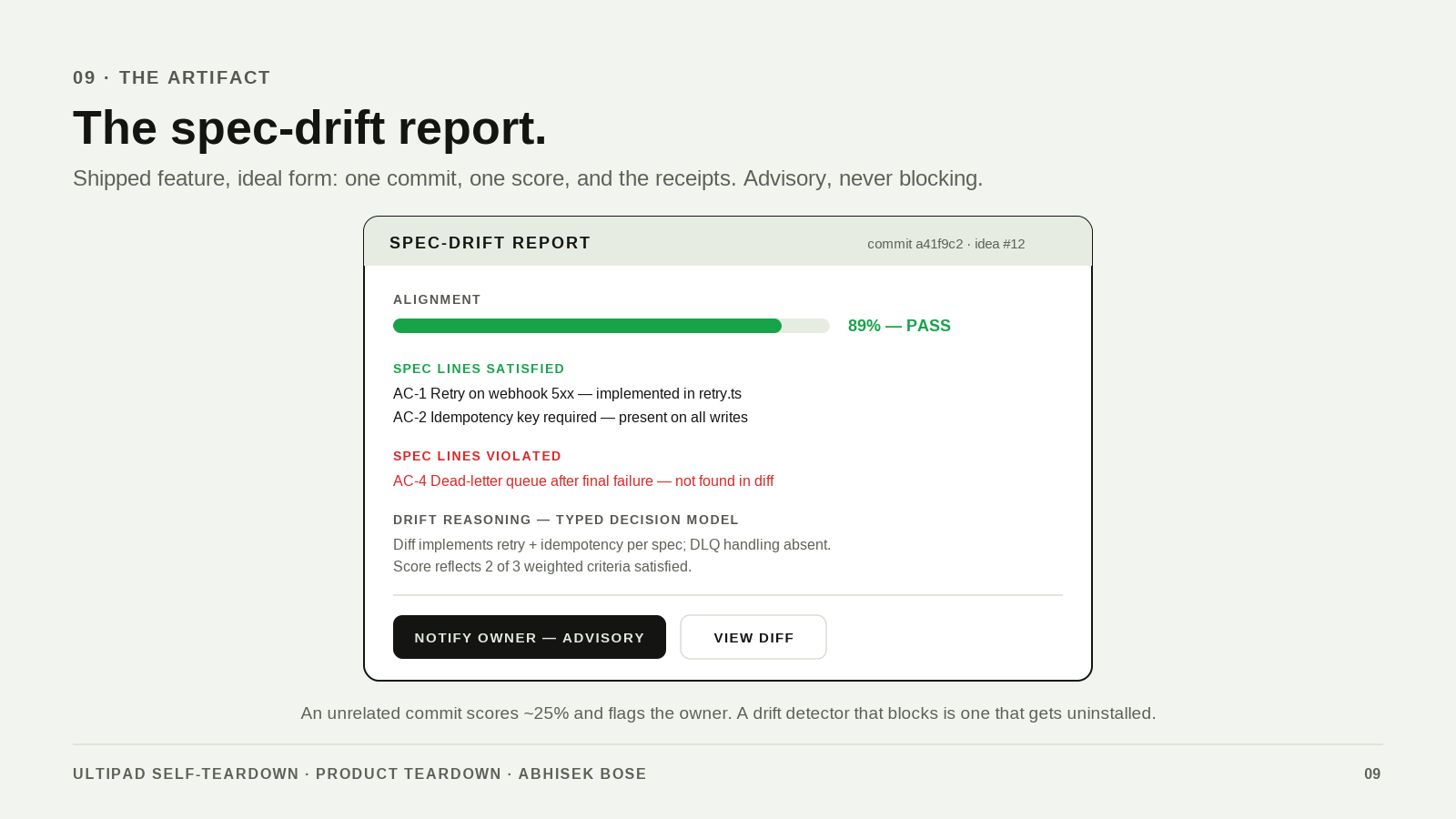
One commit, one score, and the receipts: which spec lines the diff satisfies, which it violates, and why.
Every element earns its place: the commit ref anchors the report to a real diff, the alignment score makes drift legible at a glance, the satisfied/violated spec lines turn a number into an argument, the reasoning from the typed decision model makes the flag auditable rather than oracular, and the advisory flag routes to the owner without blocking the merge — because a drift detector that blocks is a drift detector that gets uninstalled (illustrative estimate on that last claim, but I'd bet the product on it, and did).
10 · The interaction: advisory-to-gate escalation
Designed, not shipped — this is roadmap. Advisory-forever is the right starting posture and the wrong permanent one. The escalation: after N repeated drift flags on a protected path, the system proposes upgrading advisory to blocking for that path. The owner accepts or declines. Trust escalates per-path, never globally — the payment module can earn a hard gate while the marketing pages stay advisory.
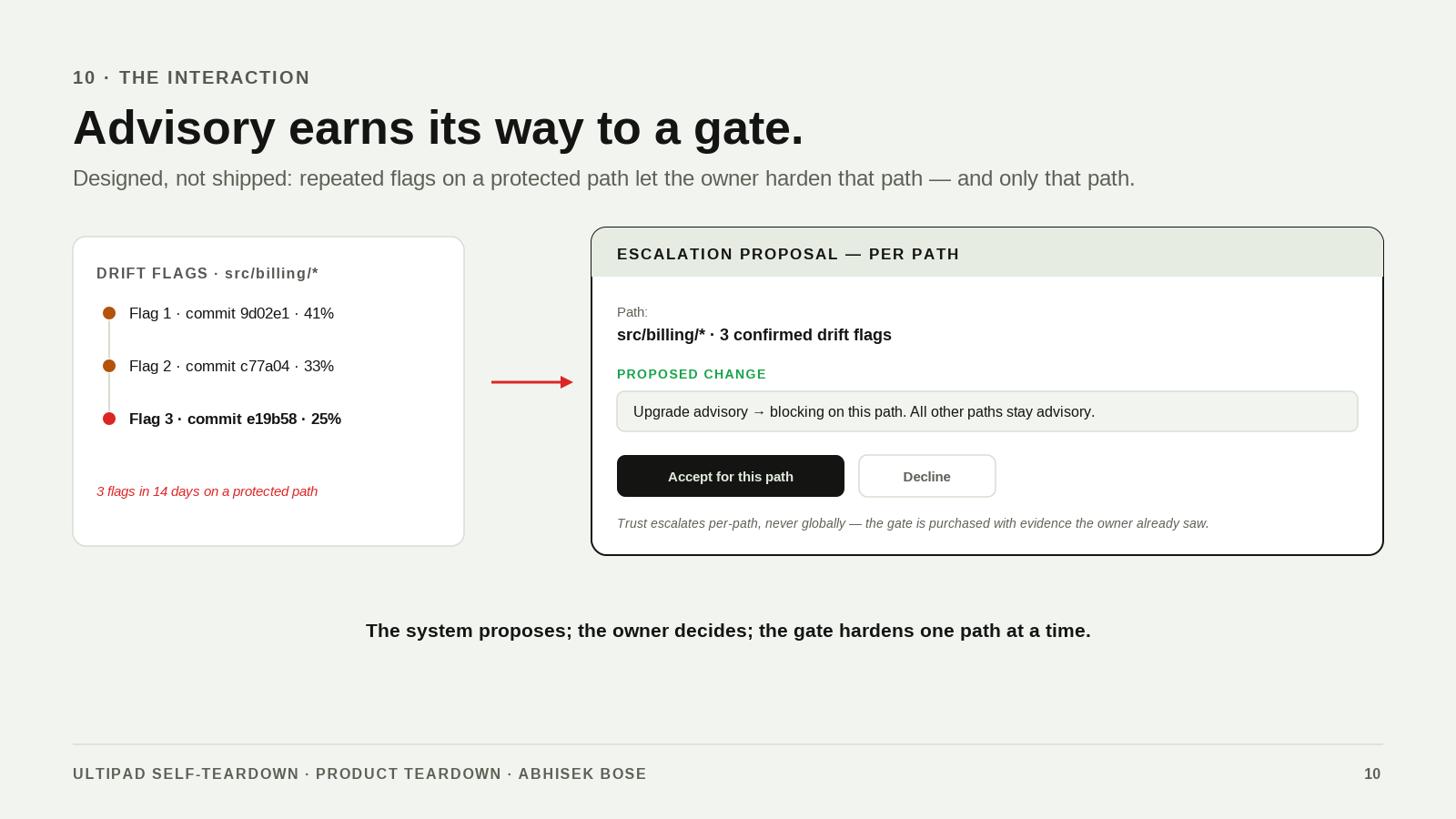
The system proposes; the owner decides; the gate hardens one path at a time.
This is the "earn the ceremony" thesis made mechanical: the gate starts free, and every escalation is purchased with evidence the owner already saw.
11 · Category view: trust models, not feature lists
Comparing Ultipad to Jira on features misses the point of both. Compare the trust abstraction each pattern ships:
| Product pattern | Trust model |
|---|---|
| PM tools (Jira, Linear) | Human-to-human handoffs; stops at delivery; blind to agents |
| Prompt-context tools (rules files, CLAUDE.md) | Static context; no approval, no write-back, no measurement |
| Agent frameworks with their own tasking | The agent grades its own homework |
| ADLC — spec gate + write-back (Ultipad) | Approved intent in, scored commits out |
The open position in the category isn't the fourth row — Ultipad holds that. The open position is the fourth row without the front-loaded ceremony: earn the gate instead of demanding it. Nobody has shipped that, including me.
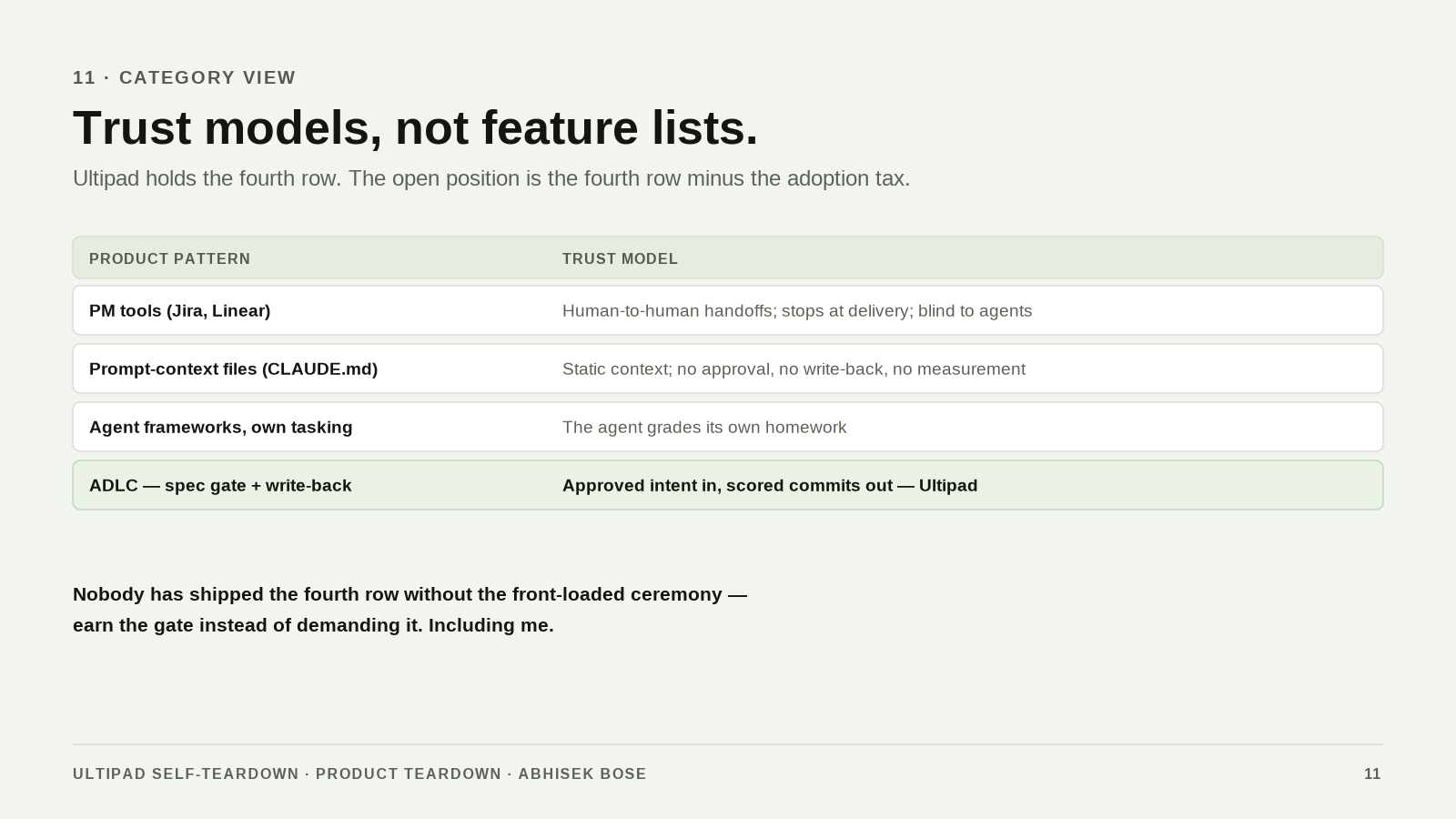
Ultipad holds the fourth row. The prize is the fourth row minus the adoption tax.
12 · Metrics that would prove the thesis
Not vanity numbers. Each metric tests one link in the loop:
- Loop completion rate — % of shipped commits traced to an approved spec. The headline number.
- Spec-before-code rate — % of specs approved before the first commit lands, not backfilled after.
- Bypass rate — % of agent sessions with no MCP pull. The metric from section 07, made first-class instead of invisible.
- Drift-flag precision — % of flags the owner confirms as real drift. A flag stream nobody trusts is noise with a dashboard.
- Time-to-approved-spec — the ceremony cost, measured instead of argued about.
- Weekly active loops — complete evidence-to-measured-outcome cycles per week. The retention number.
Honest note: dogfooding measures none of these adversarially. I am one user who believes in the product, follows the ceremony because I invented it, and never bypasses the loop on a deadline. That is the weakest possible eval set — the 97%-traceable dogfood number proves the loop can close, not that anyone else will close it.
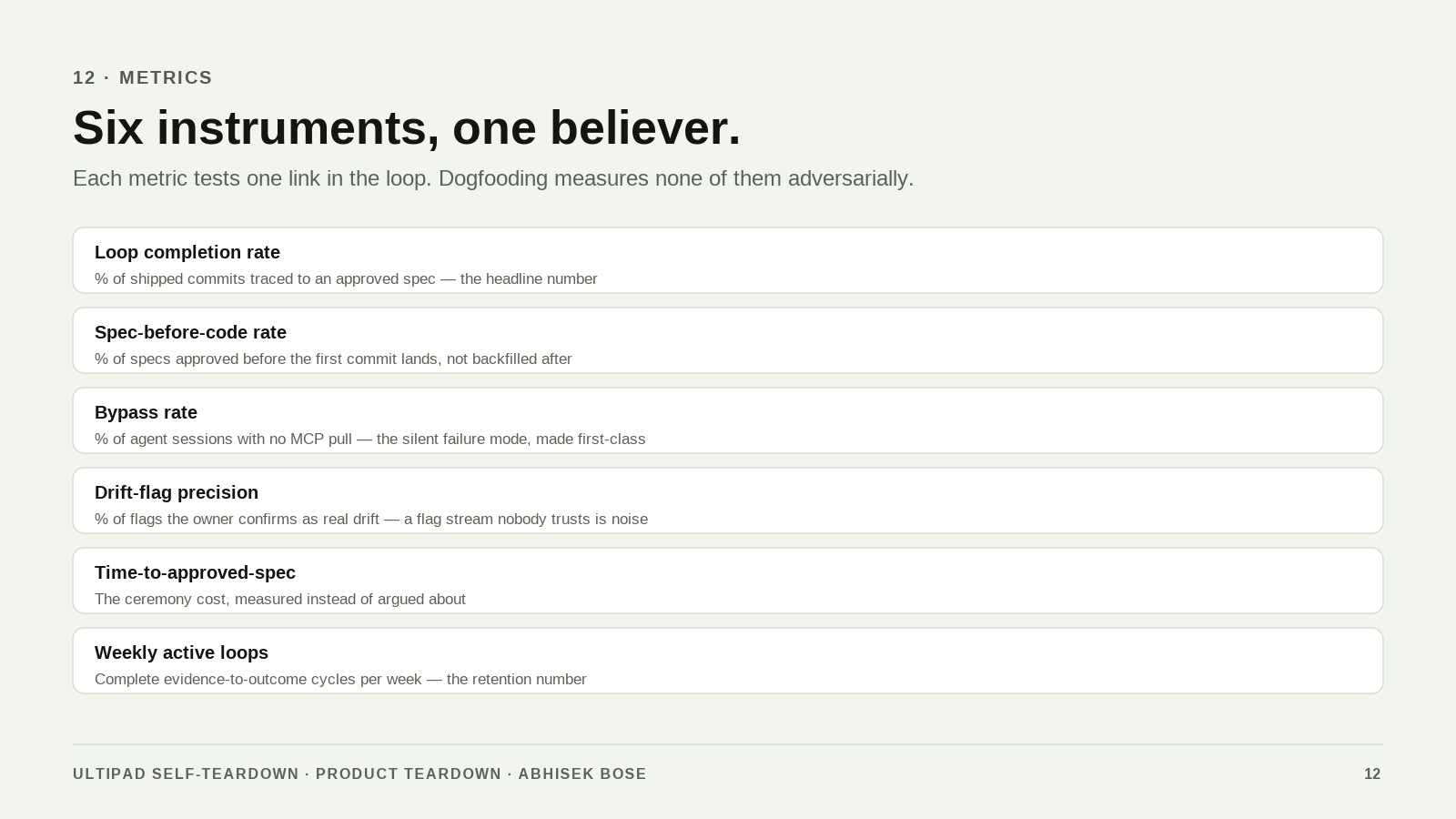
Six instruments — and an admission that the current sample size of believers is one.
13 · The experiment
Don't invert the onboarding on conviction. Run the test:
Control: ceremony-first onboarding — evidence, decision, spec, approval, then agent value. The current product. Treatment: value-first onboarding — auto-drafted spec from the user's first prompt, retroactive cheap approval, evidence attached later.
Hypothesis: value-first onboarding raises week-4 loop completion rate without raising drift incidents.
Guardrail: spec approval must stay human. If the auto-draft flow quietly becomes auto-approve, the treatment didn't lower the gate — it deleted it, and the experiment measures a different product.
Kill criterion: if teams using the full gate ship wrong features at the same rate as teams without it, the gate is theater and Ultipad is a documentation tool with an MCP server. I'd rather learn that from a cohort than from churn.
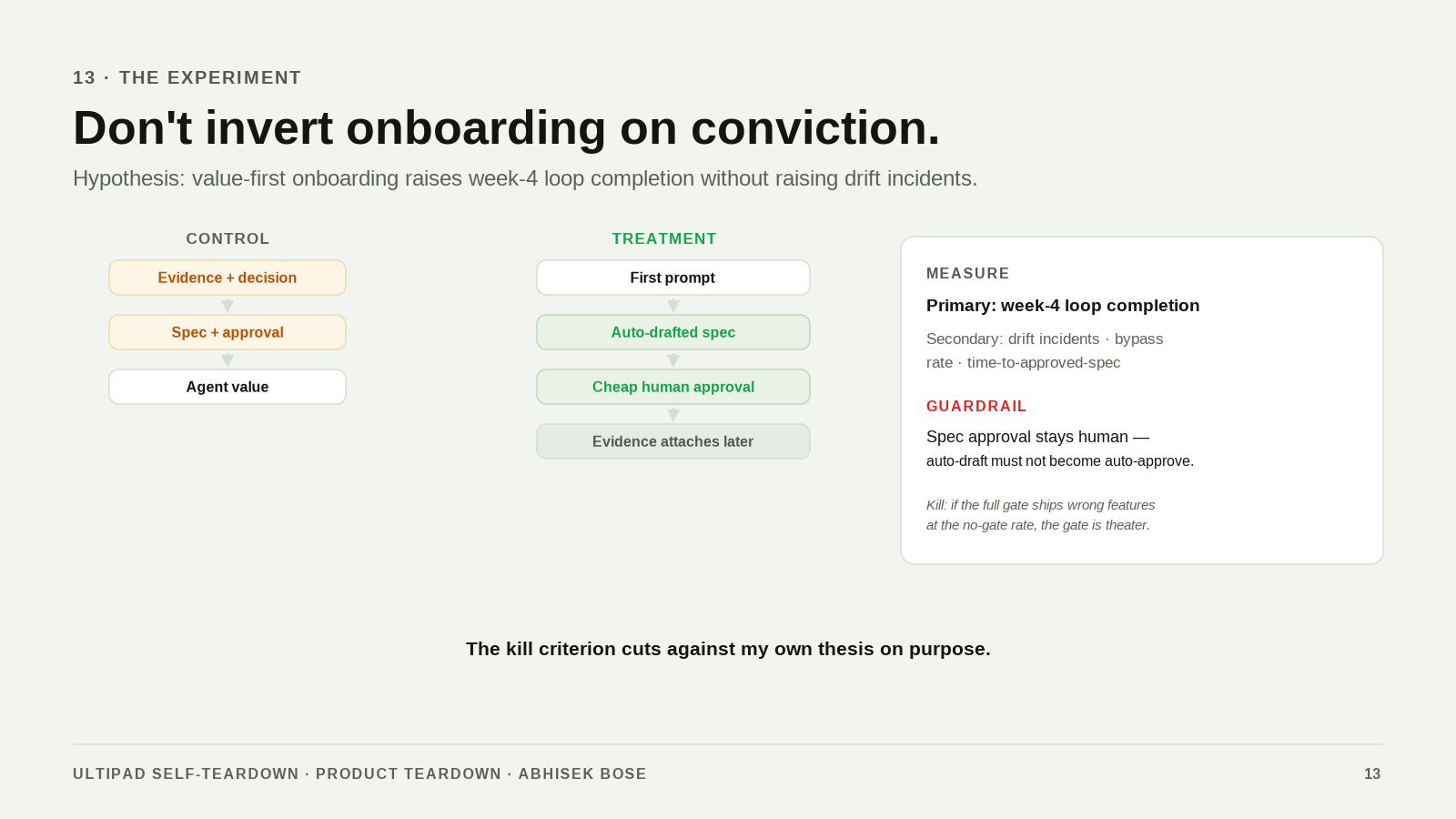
Falsifiable, guardrailed — and the kill criterion cuts against my own thesis on purpose.
14 · What I'd build first
| Feature | Impact | Effort | Priority |
|---|---|---|---|
| Auto-drafted specs from the first prompt | High | Medium | P0 |
| Bypass detection (sessions without MCP pull) | High | Medium | P0 |
| Advisory-to-gate escalation per path | High | Medium | P1 |
| Evidence auto-capture from support/analytics | High | High | P1 |
| Team trust dashboard | Medium | Medium | P2 |
| Multi-agent conformance | Medium | High | P2 |
The P0 pair attacks both break points from section 06: auto-drafted specs kill the cold start, bypass detection makes the silent failure mode visible. Everything else is compounding, not foundational.
15 · Final thesis
Building the trust layer taught me the trust layer is bought with delivered speed, not argued with principle. Nobody adopts governance because the argument is good — they adopt it because the product was already making them faster, and the governance came attached.
The products that win agentic development won't demand ceremony up front. They'll deliver value at the prompt and convert it into governance — one auto-drafted spec, one cheap approval, one earned gate at a time. That's the roadmap this teardown just wrote.
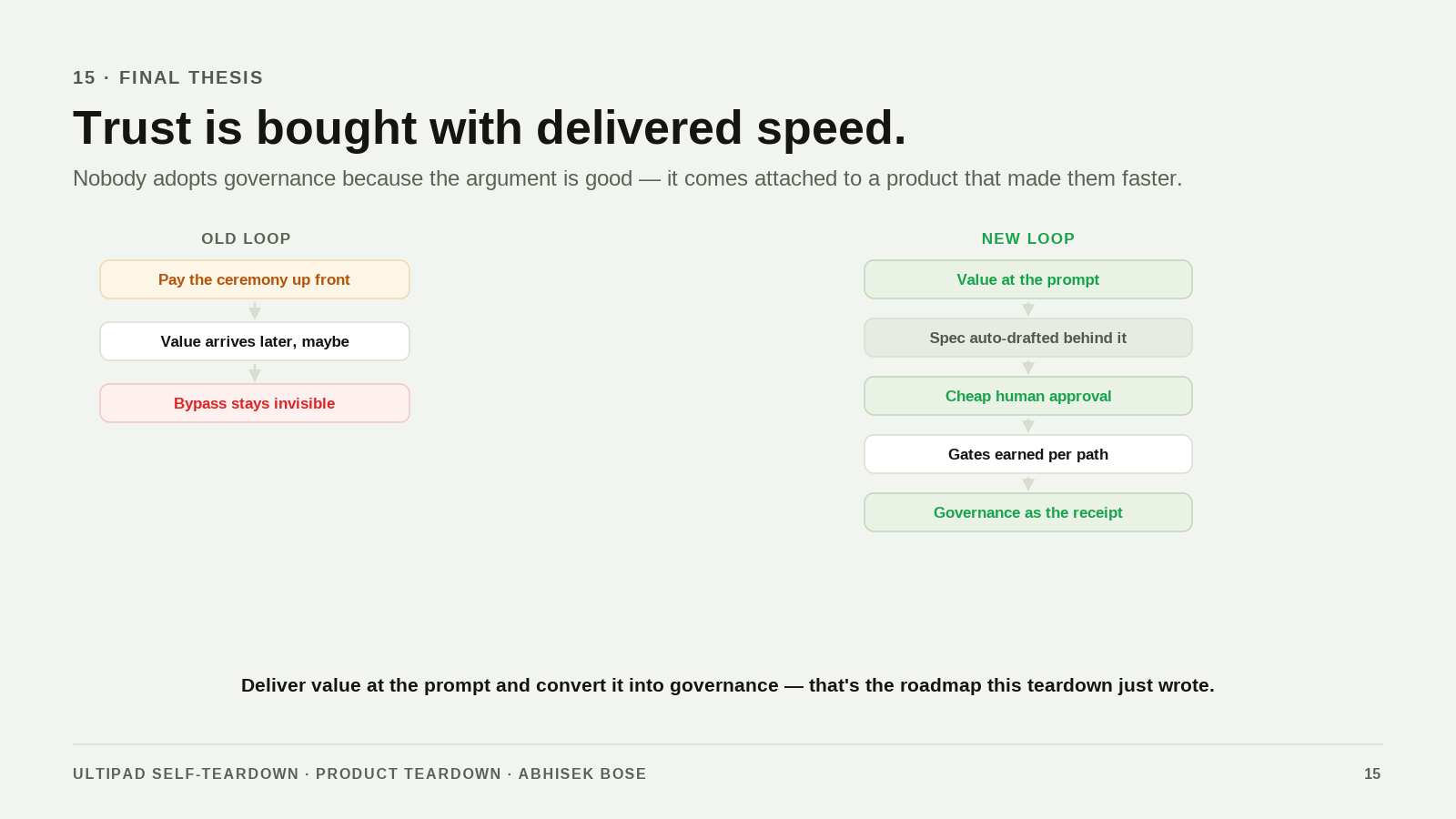
Old loop: pay first, benefit later. New loop: benefit at the prompt, governance as the receipt.
Sources
- UltiPad case study — the product facts, loop architecture, and verified drift numbers
- UltiPad live — the product itself, in open beta
- Spec-drift detection: Claude broke the ADLC and AI can write perfectly valid code that is completely wrong for the product — the drift-detection system in practice
This is a self-teardown — the conflicts of interest are total, which is exactly why the kill criteria are real.