People ask me some version of the same question every week: how do I become an AI Product Manager?
The honest answer is that the title is less important than the shift underneath it. An AI PM isn't a PM who uses ChatGPT to write PRDs. It's a PM whose product makes probabilistic decisions: it can be wrong in ways traditional software can't, every request has a cost, and "done" means "measured," not "shipped."
That changes the job. You still do discovery, prioritization, and strategy. But you also have to decide whether something should be AI at all, define what "good" looks like before the model exists, pick an architecture that limits the damage when it fails, and put a price on every answer.
This roadmap is what I'd follow if I were starting over. It's 11 stages in four phases. Every stage has what to learn, a small thing to build or write so you can prove you learned it, and the best free resources I could find. I checked every link on 26 September 2026.
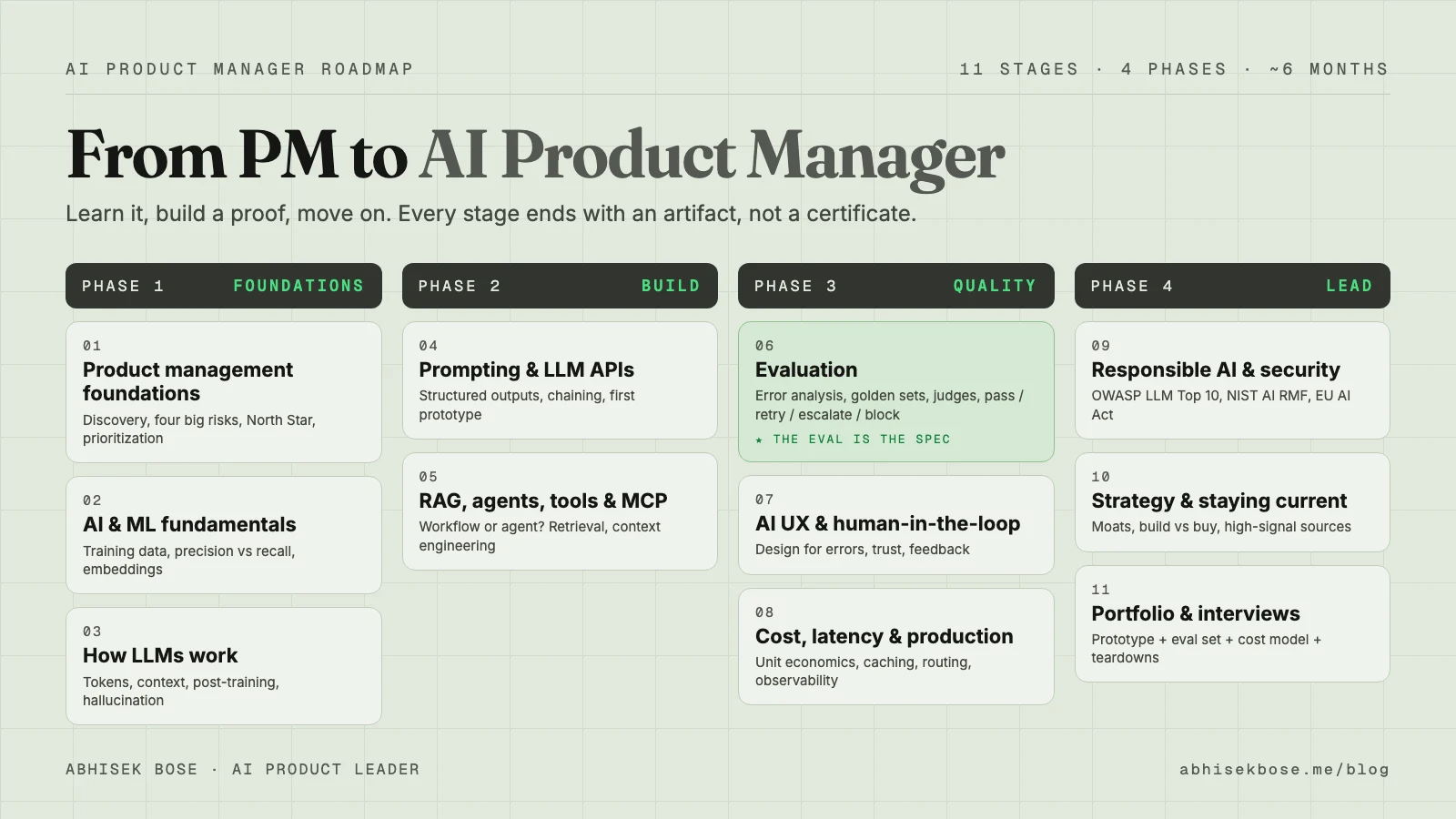
How to use this roadmap
- Go in order, but don't wait for perfect. Phases 1 and 2 overlap. Start building (stage 4) while you're still watching the LLM videos (stage 3).
- Build a proof for each stage. A note, a teardown, a prototype, an eval set. Reading without artifacts is how people end up "learning AI" for a year with nothing to show for it.
- Stage 6 (evals) is the one to over-invest in. If you only have time to go deep on one thing, make it evaluation. It's the skill that most separates AI PMs from PMs who ship AI demos.
- Time: at 6–8 hours a week, the whole roadmap takes about six months. There's a plan at the end.
A quick note on "free": everything below is free to read or watch, or free to audit (Coursera courses let you watch without paying for the certificate). Where something is only partly free, I say so.
Phase 1: Foundations
Stage 1: Product management foundations
AI doesn't replace the fundamentals. It punishes you for skipping them. The most common AI product failure I see isn't a bad model. It's a team that never validated the problem, bolted AI onto it, and then couldn't say whether it worked.
What to learn
- Continuous discovery: talking to customers every week, not once per quarter
- The four big risks: value, usability, feasibility, viability (AI makes feasibility and viability much harder to judge)
- Outcome-based roadmaps and a North Star metric with input metrics
- Prioritization you can defend (RICE is fine; the point is making trade-offs explicit)
- Writing clearly: specs, decision docs, and one-page narratives
Proof it: write a one-page opportunity brief for a product you use. Include the outcome, the opportunity tree, the riskiest assumption, and how you'd test it in a week.
Free resources
- The Four Big Risks · Marty Cagan (SVPG) · article. The lens behind all good discovery.
- SVPG articles · Marty Cagan · articles. The full back catalogue on empowered teams and the product operating model.
- Opportunity Solution Trees · Teresa Torres · article. The core tool of continuous discovery.
- Everyone Can Do Continuous Discovery—Even You! · Teresa Torres · article. A practical way to start weekly customer touchpoints.
- North Star Playbook · Amplitude · free ebook. How to choose a North Star and its input metrics.
- RICE: simple prioritization for product managers · Intercom · article. The original RICE write-up.
- The art of product management · Shreyas Doshi on Lenny's Podcast · video. Pre-mortems, LNO, and the three levels of product work.
Stage 2: AI and ML fundamentals
You don't need to train models. You do need to know what ML is good and bad at, what training data does, why models are confidently wrong, and what "accuracy" hides. Without this, you can't have a real conversation with your engineers or push back on a vendor.
What to learn
- Supervised vs. unsupervised learning, classification vs. regression, what a model "learns"
- Training, validation and test data, overfitting, and why data quality beats model choice
- Precision, recall, false positives and false negatives, and which one hurts your users more
- Embeddings: turning text into vectors (you'll need this for RAG)
- The ML project lifecycle and why most ML projects stall before production
Proof it: pick an AI feature you use (spam filter, recommendations, fraud alerts). Write down what it predicts, what data it probably learns from, what a false positive and a false negative cost the user, and which one the product should optimize against.
Free resources
- AI For Everyone · Andrew Ng · course, free to audit. The best non-technical first course on what AI can and can't do.
- Generative AI for Everyone · Andrew Ng · course, free to audit. The GenAI follow-up: use cases, project lifecycle, business impact.
- Machine Learning Crash Course · Google · course. Fast and hands-on: classification, embeddings, and production ML concerns.
- Neural networks playlist · 3Blue1Brown · video. The clearest visual intuition for how networks learn.
- Elements of AI · University of Helsinki · course. Gentle, math-light, with a certificate.
- Practical Deep Learning for Coders · fast.ai · course. Optional, for PMs who want to train models themselves.
Stage 3: How LLMs work
Most AI products today are built on large language models. You need a working mental model of what happens between the prompt and the answer: tokens, context windows, pretraining vs. post-training, why hallucinations happen, and why the same prompt can give different answers.
What to learn
- Tokens, context windows, and why long inputs cost more and get slower
- Pretraining, fine-tuning, and RLHF, and what each one changes
- Temperature and sampling: why outputs vary
- Hallucination as a property of the system, not a bug you can "fix" once
- Tool use and reasoning models, at a conceptual level
Proof it: explain to a non-technical friend, in five minutes and without jargon, why an LLM can cite a source that doesn't exist. If you can't, rewatch the Karpathy talk.
Free resources
- Intro to Large Language Models (1-hour talk) · Andrej Karpathy · video. The best one-hour mental model of LLMs. Start here.
- Deep Dive into LLMs like ChatGPT · Andrej Karpathy · video. 3.5 hours on pretraining, post-training, hallucinations and tool use. Worth every minute.
- Large Language Models explained briefly · 3Blue1Brown · video. An 8-minute primer before the long stuff.
- Transformers, the tech behind LLMs · 3Blue1Brown · video. Embeddings and attention, visually.
- The Illustrated Transformer · Jay Alammar · article. The classic diagram-led explanation.
- Transformer Explainer · Georgia Tech Polo Club · interactive. Runs GPT-2 in your browser so you can watch tokens flow.
- Hugging Face LLM Course · Hugging Face · course. Structured, from transformer basics to fine-tuning.
Phase 2: Build
Stage 4: Prompting and building with LLM APIs
This is where you stop reading and start building. An AI PM who has never called an API, written a system prompt, or watched a prototype fail on real inputs is guessing. You don't need to be an engineer. You do need to have built something small end to end.
What to learn
- Writing clear prompts: role, context, examples, output format
- Structured outputs (JSON) so your application can use the result
- Prompt chaining: splitting a task into steps
- Calling a model API, reading token usage, and estimating cost
- Prototyping with no-code or AI coding tools, then knowing when a prototype is lying to you
Proof it: build a tiny tool that solves one annoying task for you, such as summarizing support tickets into categories, and run it on 30 real examples. Write down where it failed.
Free resources
- Prompt engineering overview · Anthropic · docs. Detailed, official techniques: clarity, examples, structure, chaining.
- Interactive Prompt Engineering Tutorial · Anthropic · notebooks. Nine hands-on chapters with exercises.
- Prompt engineering guide · OpenAI · docs. OpenAI's official guide.
- Prompt design strategies · Google · docs. Useful for comparing styles across providers.
- ChatGPT Prompt Engineering for Developers · DeepLearning.AI & OpenAI · short course. One hour, the course that started the genre.
- Anthropic Courses · Anthropic · notebooks. API fundamentals, prompt evaluations, and tool use.
- Claude Cookbooks · Anthropic · code. Copyable recipes for classification, RAG, tool use and more.
- Google AI Studio · Google · tool, free tier. The fastest free way to prototype prompts and get an API key.
Stage 5: RAG, agents, tools and MCP
Most real AI products aren't "a prompt." They're systems: retrieval that feeds the model the right context, tools the model can call, and sometimes agents that take multi-step actions. The PM's job here is architectural judgment, not implementation. You need to be able to answer the hardest question in agentic AI: should this be an agent at all?
I use a simple test for that, the AIM framework: score the problem on five dimensions before deciding how much autonomy it deserves. A lot of "agent" ideas turn out to be a workflow with one LLM step.
What to learn
- RAG: chunking, embeddings, retrieval, reranking, and grounding answers in sources
- The difference between a workflow (you define the steps) and an agent (the model decides the steps)
- Tool design, and why most agent failures are really tool and context failures
- Context engineering: what the model sees on each step
- MCP (Model Context Protocol) as the standard way to connect models to tools and data
- Guardrails, human approval steps, and how agents fail in production
Proof it: take your stage 4 tool and add retrieval over a small document set, like your team's docs. Then write a one-page decision doc: workflow or agent, and why.
Free resources
- Building Effective AI Agents · Anthropic · article. Workflows vs. agents and the core patterns. Required reading.
- A practical guide to building agents · OpenAI · PDF. When to build an agent, orchestration, and guardrails, framed for product teams.
- Agents · Chip Huyen · article. Tools, planning, and agent failure modes, rigorously.
- Writing effective tools for AI agents · Anthropic · article. Why tool design decides agent success.
- Effective context engineering for AI agents · Anthropic · article. What comes after prompt engineering.
- Contextual Retrieval · Anthropic · article. A concrete RAG improvement with measured results.
- Introduction to RAG · LlamaIndex · docs. Clear breakdown of the RAG stages.
- Retrieval Augmented Generation · DeepLearning.AI · course, free to audit. Retrieval, evaluation, and production RAG.
- What is the Model Context Protocol? · MCP project · docs. The official introduction.
- MCP: Build Rich-Context AI Apps with Anthropic · DeepLearning.AI & Anthropic · short course. Hands-on MCP.
Phase 3: Quality
Stage 6: Evaluation (the most important stage)
If you remember one thing from this roadmap, make it this: in AI products, the eval is the spec. A traditional PRD says what the feature does. For an AI feature, you can't know whether it does that until you've defined how you'll measure it on real inputs.
Most teams skip this. They "vibe check" a few demo prompts, ship, and find out about failures from users. The PMs I'd hire are the ones who define success criteria before the model is chosen, look at real outputs every week, and turn failures into test cases.
What to learn
- Error analysis: reading real outputs and naming the failure modes before writing metrics
- Building a golden dataset from real examples, including the ugly edge cases
- Code-based checks, LLM-as-a-judge, and human review, and when each one fits
- Aligning an LLM judge with a domain expert (a judge you haven't validated is just another opinion)
- Faithfulness and grounding for RAG; task completion for agents
- Offline evals before release vs. online monitoring in production
- Turning an eval score into a product decision: pass, retry, escalate, or block
I've written about how I do this in practice: the three-phase eval pipeline I run on production AI, and why a lot of evaluation doesn't need an LLM judge at all. Code checks rules, decision models answer "is it true?", and LLMs explain why something failed.
Proof it: take your stage 5 prototype and build a 50-example eval set from real inputs. Label each example pass or fail by hand, write down the top three failure modes, add one automated check per failure mode, and track the score across two prompt versions. That one artifact will say more in an interview than any certificate.
Free resources
- Your AI Product Needs Evals · Hamel Husain · article. The foundational essay. Read it first.
- A Field Guide to Rapidly Improving AI Products · Hamel Husain · article. Error analysis first, then everything else.
- AI Evals FAQ · Hamel Husain & Shreya Shankar · article. Practitioner answers to the questions every team asks.
- Using LLM-as-a-Judge: A Complete Guide · Hamel Husain · article. How to build a judge that agrees with your expert.
- Why AI evals are the hottest new skill for product builders · Hamel Husain & Shreya Shankar on Lenny's Podcast · video. The full eval process, framed for PMs.
- Task-Specific LLM Evals that Do & Don't Work · Eugene Yan · article. Which metrics actually work for which tasks.
- An LLM-as-Judge Won't Save the Product—Fixing Your Process Will · Eugene Yan · article. Evals as a process, not a tool.
- Patterns for Building LLM-based Systems & Products · Eugene Yan · article. Seven core patterns, evals first.
- What We've Learned From A Year of Building with LLMs · six practitioners · article. Tactical, operational, and strategic lessons. Bookmark it.
- Who Validates the Validators? · Shreya Shankar et al. · paper. Criteria drift, and aligning judges with human preference.
- Demystifying evals for AI agents · Anthropic · article. Evaluating multi-step agents, not just single answers.
- Define success criteria and build evaluations · Anthropic · docs. From success criteria to test cases and graders.
- Working with evals · OpenAI · docs. OpenAI's evals guide and API.
- Langfuse evaluation docs · Langfuse · docs, open source. Datasets, judges, and human annotation in a real tool.
- Ragas metrics · Ragas · docs, open source. Reference for faithfulness, context precision, and other RAG metrics.
Stage 7: AI UX and human-in-the-loop
AI features fail differently, so they need to be designed differently. Users need to know what the system can do, when to trust it, how to correct it, and what happens when it's wrong. The worst AI UX hides uncertainty. The best makes the right amount of it visible.
What to learn
- Setting expectations: what the AI can and can't do, shown in the product and not only in the docs
- Designing for errors: graceful failure, easy correction, and undo
- Showing sources and confidence without overwhelming users
- Where the human stays in the loop: approval steps, review queues, escalation
- Collecting feedback that actually improves the system (thumbs up is rarely enough)
Proof it: redesign one AI feature you use for failure. Sketch three screens: what the user sees when the AI is right, when it's unsure, and when it's wrong.
Free resources
- People + AI Guidebook · Google PAIR · guide. Mental models, explainability, feedback, and graceful failure.
- Guidelines for Human-AI Interaction · Microsoft HAX Toolkit · guide. 18 research-validated guidelines with examples.
- The Shape of AI · Emily Campbell · pattern library. Real AI UX patterns for inputs, trust, and governance.
- AI: First New UI Paradigm in 60 Years · Jakob Nielsen (NN/g) · article. Intent-based outcome specification.
- AI Hallucinations: What Designers Need to Know · NN/g · article. Designing for a system that will be wrong.
- NN/g AI topic hub · NN/g · articles (courses are paid). Ongoing UX research on AI.
Stage 8: Cost, latency and production
This is where AI product management gets most different from traditional software. In normal SaaS, the marginal cost of a request is close to zero. In AI products, every answer has a price and a delay, and both scale with usage. A feature that looks great in a demo can lose money at scale, or be too slow for anyone to wait for.
What to learn
- Unit economics: cost per request, per user, per task, and how it compares with what you charge
- The main levers: model choice, prompt length, caching, batching, and routing easy requests to cheaper models
- Latency budgets, streaming, and perceived speed
- Observability: logging inputs, outputs, cost, and quality in production
- Why inference prices keep falling, and how that changes your roadmap
Proof it: build a one-page cost model for your prototype. Include tokens per request, cost per 1,000 requests on two models, and the break-even price per user.
Free resources
- Building A Generative AI Platform · Chip Huyen · article. End-to-end architecture: context, guardrails, routing, caching, observability.
- Building LLM applications for production · Chip Huyen · article. Cost, latency, and prompting vs. fine-tuning.
- LLM Bootcamp · Full Stack Deep Learning · video course. Dated (2023), but the LLMOps lecture foundations still hold.
- Welcome to LLMflation · a16z · article. Why inference costs fall so fast, and what that means for planning.
- Prompt caching · Anthropic · docs. The biggest single lever for cost and latency on repeated context.
- Prompt caching · OpenAI · docs. How OpenAI's automatic caching works.
- Latency optimization · OpenAI · docs. Seven principles for faster LLM apps.
- Reducing latency · Anthropic · docs. Model choice, streaming, and prompt length.
- Pricing pages to compare: Anthropic · OpenAI · Google Gemini.
Phase 4: Lead
Stage 9: Responsible AI, safety and security
As the PM, you own the consequences of what your AI does. That means knowing the regulatory landscape well enough to ask the right questions, understanding how AI systems get attacked (prompt injection is the new SQL injection), and designing safeguards before launch, not after an incident.
What to learn
- Risk tiers: which uses are high-risk and what that means for your product
- Prompt injection, data leakage, excessive agency, and other LLM-specific attacks
- Bias, fairness, and who your system might fail more often
- Privacy: what user data reaches the model, and where it goes
- Governance: documentation, audit trails, and incident response
Proof it: run the OWASP Top 10 for LLMs against your prototype. List which risks apply, what you'd do about each, and what you'd accept.
Free resources
- OWASP Top 10 for LLM Applications 2025 · OWASP · checklist. Prompt injection, data leakage, excessive agency. The standard security list.
- AI Risk Management Framework · NIST · framework. Govern, Map, Measure, Manage. The AI RMF Playbook turns it into actions.
- AI RMF: Generative AI Profile · NIST · document. GenAI-specific risks and actions.
- EU AI Act · European Commission · official page. Risk tiers and timeline.
- High-level summary of the AI Act · Future of Life Institute · article. The most readable summary; the AI Act Explorer lets you browse the text.
- Google AI Principles and Microsoft Responsible AI · policies. How two large AI companies frame responsibility.
Stage 10: Strategy and staying current
The AI landscape moves weekly, but strategy questions stay the same: where is value created, who captures it, what gets commoditized, and what stays defensible. Don't try to read everything. Pick a few high-signal sources and ignore the rest.
What to learn
- The AI stack (models, infrastructure, applications) and where margins sit
- Build vs. buy vs. wrap, and when a "thin wrapper" is actually a real product
- What stays defensible when models improve every few months: workflow, data, distribution, trust
- How enterprises actually buy AI
- A personal system for staying current in 30 minutes a day
Proof it: write a short teardown of one AI product. Cover what problem it solves, where its moat is, what happens to it when the next model ships, and what you'd build next. (I do these on my site as product teardowns.)
Free resources
- Simon Willison's Weblog · Simon Willison · blog. The most reliable hands-on daily read on LLMs.
- State of AI Report · Air Street Capital · annual report. Research, industry, policy, and safety in one read.
- One Useful Thing · Ethan Mollick · newsletter. Evidence-based takes on AI and work.
- AI's $600B Question · Sequoia · article. The gap between AI investment and AI revenue.
- 16 Changes to the Way Enterprises Are Building and Buying Generative AI · a16z · article. How enterprises actually budget for AI.
- AI and the Big Five · Ben Thompson · article. How AI shifts incumbents' strategy (builds on Aggregation Theory).
- The Rise of the AI Engineer · swyx (Latent Space) · article. The role you'll work alongside, plus the Latent Space podcast.
- Why most AI products fail: lessons from 50+ AI deployments · Lenny's Podcast · video. Lessons from people who shipped AI at OpenAI, Google, and Amazon.
- AI Product Management · Marty Cagan · article. How AI changes the PM's risks and responsibilities.
Stage 11: Portfolio and interviews
Nobody hires an AI PM for a certificate. They hire for evidence of judgment. The good news is that if you did the "proof it" step at each stage, you already have a portfolio.
What your portfolio should show
- One shipped (or deployed) prototype, even a small one, with a public demo
- An eval set and what you learned from it. This is the strongest signal you can send.
- A cost model showing you think about unit economics
- Two or three written teardowns or decision docs showing product judgment
- A short write-up of a failure: what broke, how you found it, what you changed
How to answer AI product questions in interviews
In interviews, and in real work, I walk through the same seven questions for any AI feature:
- Should this be AI at all?
- Is the data sufficient?
- What is the acceptable failure mode?
- Which architecture minimizes risk?
- How will we evaluate it?
- What does it cost at production scale?
- Where does human judgment remain?
If you can answer those clearly for any product an interviewer throws at you, you'll stand out from candidates who jump straight to "we'd use GPT to…".
Free resources
- Claude Academy · Anthropic · courses. Official courses on building with Claude.
- Claude Quickstarts · Anthropic · code. Deployable starter apps, like a customer support agent.
- Get started with Claude and OpenAI developer quickstart · docs. Your first API call in minutes. See also the OpenAI Cookbook.
- Hugging Face Spaces · Hugging Face · platform, free tier. Host a public demo as portfolio proof.
- Kaggle Learn · Kaggle · micro-courses. Short and browser-based; start with Intro to Machine Learning.
- Product Sense Interview Prep · Aced (formerly Exponent) · article. Frameworks and worked examples.
- How to develop product sense · Lenny Rachitsky · free post. Building product intuition deliberately.
If you want deeper, structured practice, I've written three playbooks: Crack the AI PM Loop for interviews, Product Sense, and AI Evals. They're paid and live on Topmate. Everything else in this post is free.
A 6-month plan
At 6–8 hours a week:
| Month | Focus | Stages | End-of-month artifact |
|---|---|---|---|
| 1 | Foundations | 1, 2 | Opportunity brief + an AI feature breakdown (false positive vs. false negative) |
| 2 | LLMs + first build | 3, 4 | A small working tool, run on 30 real examples |
| 3 | Systems | 5 | Retrieval added + a "workflow or agent?" decision doc |
| 4 | Evals | 6 | A 50-example eval set, failure modes, two versions compared |
| 5 | UX + production | 7, 8 | Failure-state designs + a cost model |
| 6 | Lead + portfolio | 9, 10, 11 | OWASP review, one teardown, portfolio page, mock interviews |
Already a PM? Compress months 1–2 into two weeks and spend the saved time on stage 6.
Mistakes I see people make
- Collecting courses instead of building. Three certificates and no prototype is a weaker signal than one ugly prototype with an eval set.
- Skipping evals because they're boring. They're boring right up until your AI tells a customer something false.
- Treating the model as the product. Models are becoming a commodity. The workflow, the data, the evals, and the trust you build around them are the product.
- Starting with "agent." Most problems need a workflow with one smart step. Score the problem first.
- Ignoring cost until launch. Unit economics are a product decision, not a finance problem for later.
- Learning only one provider. Try at least two model APIs. You'll understand the trade-offs much faster.
Where to start today
Watch Karpathy's one-hour intro to LLMs tonight. Read Hamel Husain's Your AI Product Needs Evals tomorrow. Then build the smallest possible thing and run it on real inputs.
The rest of this roadmap is detail. The core habit is simple: define what good looks like, measure it on real data, and let the evidence decide what you ship. That's what makes AI products reliable in production, and it's what the best AI PMs do every week.
Links checked 26 September 2026. If one breaks, let me know and I'll update it.