The AI PM interview has changed more in the last two years than in the ten before it.
In 2022, a PM loop meant a product sense case, an analytics round, and behavioral questions. You talked about solutions. Nobody asked you to build one. In 2026, more and more loops include a round where you open Claude, Cursor, or Replit and build a working prototype in under an hour, then defend it to a panel that asks how you'd evaluate it, what it costs, and where it breaks.
That's the job now, so it's the interview now. Think like a PM, build with AI, evaluate what you built, and make a better product decision because of it.
This post is the prep roadmap I'd follow for a 2027 AI PM role: what changed, the typical interview loop, the ten competencies that loop tests, sample questions with time budgets, and an 8–12 week plan. If you're earlier in the journey and still learning the basics, start with my AI Product Manager roadmap instead. This one assumes you know what a PM does and want to get hired as an AI PM.
What actually changed
| Traditional PM (pre-2023) | 2027 AI Product Manager |
|---|---|
| Focus on software features | Focus on AI-powered experiences |
| Discuss solutions, no building | Build prototypes (vibe coding) |
| Product sense + analytics | Product sense + AI + evaluation |
| Less technical depth required | Understand models, agents, trade-offs |
| Quality = QA testing | Quality = continuous evaluation |
| Metrics: growth, revenue, engagement | Metrics: user value + AI quality + cost + trust |
| Interview: case discussion + behavioral | Interview: think → build → evaluate → defend |
Two rows matter more than the others.
Quality moved from QA to evaluation. Traditional software is deterministic: a test passes or fails, and once it passes it stays passed. AI output is probabilistic. The same input can give a different answer tomorrow, and a prompt tweak that fixes one case can quietly break ten others. So quality stops being a phase before launch and becomes a loop that runs forever. An AI PM who can't define "good" before the model exists isn't doing the job.
Metrics gained two new columns: cost and trust. Every AI answer has a price. A feature that delights users at $0.40 a request can still be a bad product. And trust is a metric, not a vibe: how often users accept, edit, or override what the AI did tells you more than engagement does.
The interview row is the one that changes your prep. "Think → build → evaluate → defend" means you'll be asked to produce something, then justify it under pressure. Talking well is no longer enough.
The AI PM interview loop (typical 2026–2027)
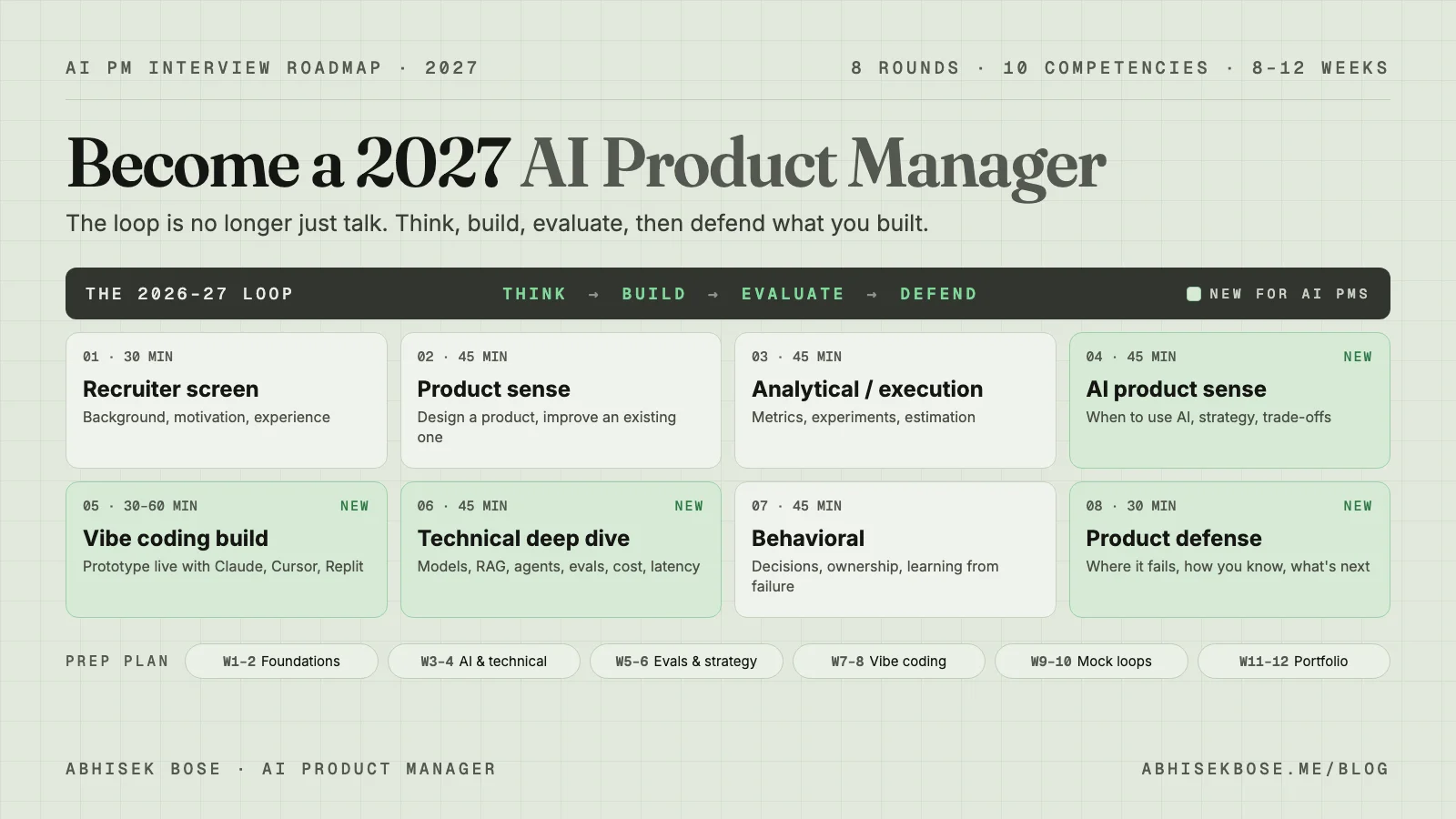
No company runs exactly this loop, and many merge rounds. But across the AI PM loops I see reported, these eight rounds show up again and again:
| # | Round | Time | What they test |
|---|---|---|---|
| 1 | Recruiter screen | 30 min | Background, motivation, experience |
| 2 | Product sense | 45 min | Design a product, improve an existing one |
| 3 | Analytical / execution | 45 min | Metrics, experiments, estimation |
| 4 | AI product sense | 45 min | When to use AI, AI strategy, trade-offs |
| 5 | Vibe coding / build round | 30–60 min | Build a prototype with AI (Claude, Cursor, Replit) |
| 6 | Technical deep dive | 45 min | Models, RAG, agents, evals, cost, latency, safety |
| 7 | Behavioral / leadership | 45 min | Past experiences, decision making, teamwork |
| 8 | Product defense | 30 min | Explain your prototype, evaluation, failures, next steps |
Rounds 1–3 and 7 are the classic PM loop. Rounds 4, 5, 6 and 8 are new, and they're where most candidates lose.
The thread that runs through all of them: problem → prototype → evaluation → impact. If every answer you give moves along that line, you'll sound like someone who has shipped AI, not someone who has read about it.
What the new rounds are really testing
AI product sense is mostly a test of restraint. The trap question is "Should this product use an LLM?" The strong answer is often "not for this part." Interviewers want to see you separate the steps that need judgment from the steps that need a lookup, a rule, or a form. I use the AIM framework for exactly this: score the problem before you pick the architecture.
The build round is not a coding test. Nobody cares if your prototype is pretty. They care whether you scoped it to one user and one job, whether you got something working end to end before polishing anything, and whether you noticed when the AI did something wrong. Narrate your trade-offs as you go. "I'm hardcoding this data so I can spend the time on the part that actually needs the model" is a great sentence to say out loud.
The technical deep dive checks whether you can hold a real conversation with your engineers. Why this model and not a smaller one? How would you cut latency in half? What does RAG fix and what doesn't it fix? You don't need to write the code. You need to know which trade-off each choice is making.
Product defense is where the build round gets graded. Expect: "Where does it fail?", "How do you know it works?", "What would you ship first?", "What's next?" The candidate who says "here are the three failure modes I found and how I'd catch them in production" beats the one with the nicer demo every time.
The 10 core competencies for 2027
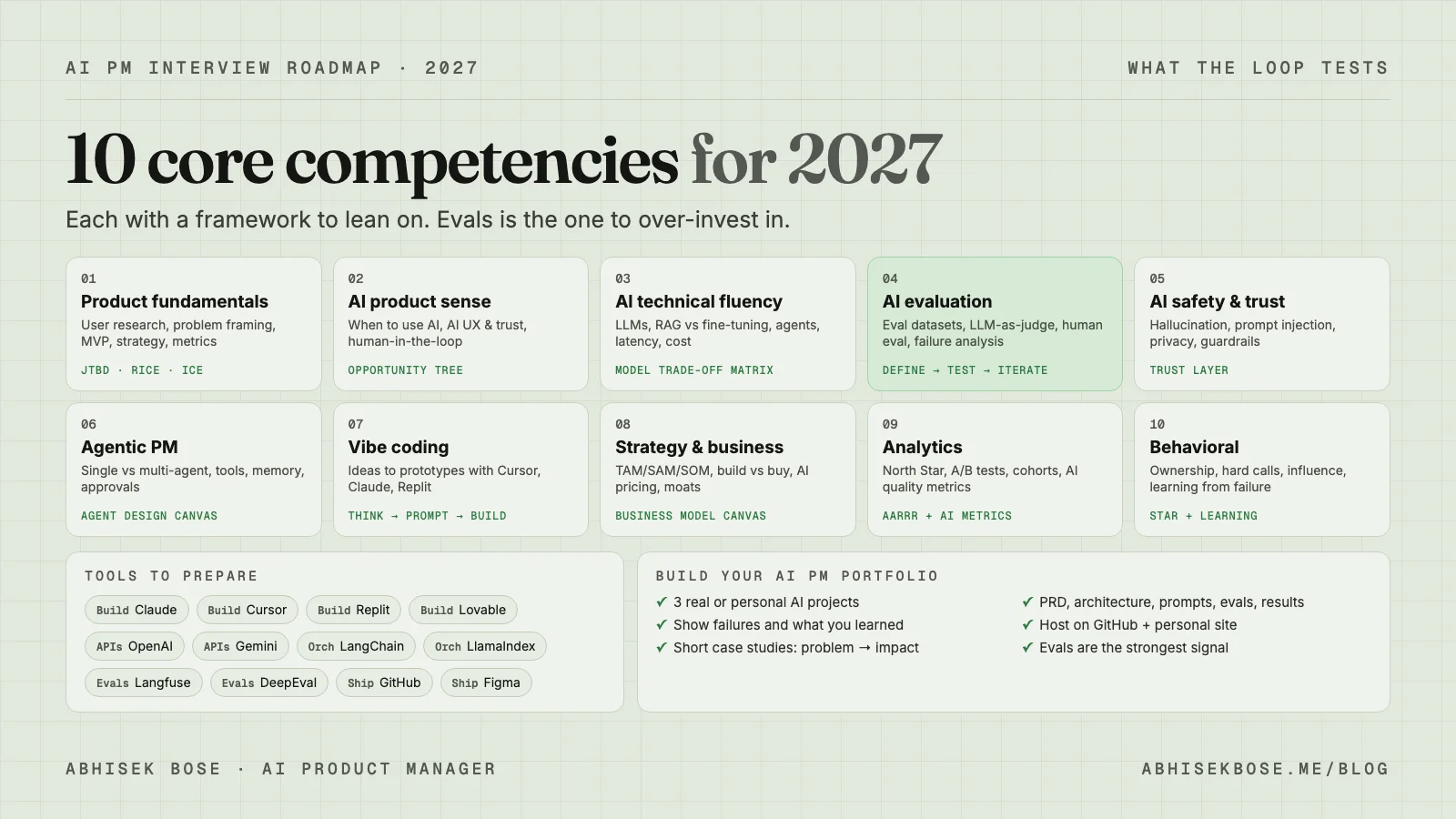
Each competency comes with a framework you can lean on in interviews. Frameworks aren't the answer, but they give your thinking a shape the interviewer can follow.
01 · Product fundamentals. User research and jobs to be done, problem framing, prioritization and MVP scoping, product strategy, metrics and experimentation. Framework: JTBD, RICE, ICE. AI doesn't replace this. It punishes you for skipping it.
02 · AI product sense. When to use AI at all, AI UX and trust, human-in-the-loop design, automation vs. augmentation, and the failure modes unique to AI. Framework: Opportunity Solution Tree. The core skill is knowing what the AI should not decide.
03 · AI technical fluency. LLMs and embeddings, RAG vs. fine-tuning, agents and tool calling, latency, cost and caching, model selection. Framework: a model trade-off matrix (quality × latency × cost × risk for each candidate model).
04 · AI evaluation (evals). Eval datasets, LLM-as-a-judge, heuristic and human evaluation, measuring accuracy, relevance and safety, and failure analysis. Framework: the eval loop: define → test → iterate. This is the one to over-invest in. If you only go deep on one competency, make it this. I've written about how I evaluate production AI and where evaluation is heading.
05 · AI safety and trust. Hallucination and bias, prompt injection, data privacy and leakage, guardrails, responsible AI. Framework: a trust layer (what the AI may do, what needs approval, what it must never do).
06 · Agentic product management. Single vs. multi-agent design, tool use and memory, agent permissions, human approval gates, failure recovery. Framework: an agent design canvas (goal, tools, permissions, memory, handoffs, stop conditions). Most problems still need a workflow with one smart step, not an agent. Say so in the interview.
07 · Vibe coding and rapid prototyping. Turning ideas into prototypes, using Cursor, Claude and Replit well, prompt engineering, iterating and testing quickly. Framework: think → prompt → build → test.
08 · Product strategy and business. TAM/SAM/SOM, build vs. buy, AI economics and pricing, the competitive landscape, distribution and defensibility. Framework: Business Model Canvas. Models are becoming a commodity, so "what's our moat?" now has a harder answer than "we use GPT."
09 · Analytics and experimentation. North Star metric, A/B testing, cohort analysis, AI quality metrics, cost vs. value trade-offs. Framework: AARRR plus AI metrics. The new skill is pairing a growth metric with a quality metric so you never ship a win on one that's a loss on the other.
10 · Behavioral and leadership. Ownership and impact, difficult decisions, cross-functional influence, learning from failure, vision and communication. Framework: STAR plus outcome and learning. Add what you learned to every STAR story. AI work fails often, and interviewers want to hear how you changed your process after it did.
Sample questions and how much time to spend
| Round | Time | Sample question | What it signals |
|---|---|---|---|
| Product sense | 45 min | How would you improve Google Maps for college students? | Product thinking |
| AI product sense | 45 min | Should this product use an LLM? How would you design it? | AI judgment |
| Vibe coding / build | 40 min | Build an app to help reduce poverty in Africa. | Prototyping |
| Evaluation | 20 min | How would you create an eval set for an AI chatbot? | Evals and quality |
| Technical deep dive | 30 min | Why this model? How would you reduce latency and cost? | Technical fluency |
| Product defense | 30 min | Why this MVP? Where does it fail? What's next? | Decision making |
| Behavioral | 30 min | Tell me about a time you failed and what you learned. | Leadership |
A few notes on handling these:
- The build prompt will be huge on purpose. "Reduce poverty in Africa" is not a spec. The first five minutes are the test: pick one user (say, smallholder farmers in one region), one job (get a fair price for their crop), and one thing you can build in 30 minutes. Scoping is the skill.
- The eval question has a short answer that most people miss. Start from real or realistic user inputs, not from the happy path. Write down what a good answer looks like for each before you run anything. Include the cases where the right answer is "I don't know" or "let me get a human." Then say how you'd grade them: code checks for format, a judge for meaning, a human for the ambiguous ones.
- "Should this use an LLM?" is a trick about half the time. Walk through the seven questions I use for any AI feature: Should this be AI at all? Is the data sufficient? What's the acceptable failure mode? Which architecture minimizes risk? How will we evaluate it? What does it cost at scale? Where does human judgment remain?
Popular build themes for vibe coding rounds
Practice on these before the real thing. They come up often because they force interesting AI trade-offs in a small scope:
- Volunteering platform
- Customer support agent
- Personalized learning app
- Travel planner for rural users
- AI recruiter or hiring assistant
- Sustainability or climate tool
- Healthcare information assistant
- Recommendation experience
- Productivity or research agent
For each one, ask yourself before building: what's the one thing the AI must never get wrong here? A healthcare assistant that sounds confident about a wrong dosage is a liability, not a feature. Your prototype should show you noticed.
The 8–12 week preparation plan
| Weeks | Focus | What to do |
|---|---|---|
| 1–2 | Foundations | Product basics, PM frameworks, metrics and strategy |
| 3–4 | AI and technical | LLMs, RAG, agents; AI trade-offs; safety and trust |
| 5–6 | Evals and strategy | Eval datasets, evaluation methods, AI economics |
| 7–8 | Vibe coding practice | Build 3–5 prototypes, practice prompting, test and iterate |
| 9–10 | Mock interviews | Full interview loops, timed build exercises, get feedback |
| 11–12 | Portfolio and polish | Document 3 AI projects, write case studies, refine stories and resume |
Already a PM with strong fundamentals? Compress weeks 1–2 into a few days and give the time to weeks 5–8. Evals and building are where the gap is for almost everyone.
The one rule I'd add: time your builds from week 7 onward. Building something in a weekend is a different skill from building something in 40 minutes while someone watches. Set a timer, pick a theme from the list above, and go. Then spend 15 minutes writing down where it fails. That second part is your product defense practice.
Tools to prepare with
- Building: Claude, Cursor, Replit, Lovable
- Model APIs: OpenAI, Gemini, Claude. Try at least two. You'll understand the trade-offs much faster.
- Orchestration: LangChain, LlamaIndex
- Evals: Langfuse, DeepEval
- Shipping and sharing: GitHub for code, Figma for flows
You don't need to master all of these. You need to have used each category enough to talk about why you'd pick one over another.
Build your AI PM portfolio
Nobody hires an AI PM for a certificate. They hire for evidence of judgment. Your portfolio is that evidence, and it's also your best preparation for the product defense round, because you'll have defended these projects to yourself already.
- 3 real or personal AI product projects. Small and real beats big and imaginary.
- For each one: the PRD, the architecture, the prompts, the evals, and the results. The evals are the strongest signal you can send.
- Show the failures and what you learned. A write-up of what broke, how you found it, and what you changed is worth more than a polished demo.
- Host it on GitHub and a personal website. Make it one click to see.
- Write short case studies: problem → solution → impact. One page each. Hiring managers skim.
Where to start this week
Pick one build theme from the list. Set a 40-minute timer and build the smallest working version with Claude or Cursor. Then write ten test inputs, including three that should make it fail, and run them. Write one paragraph on what broke.
That's the whole interview in miniature: think, build, evaluate, ship a decision. Do it twelve times over the next three months and the real loop will feel like practice.
If you want deeper, structured practice, my playbook Crack the AI PM Loop covers each round in detail. It's on Topmate.